9 cognitive reasons you can't start tasks (and how to fix each one)
Olya Zaplatynska
Last updated:
This article is a deep dive into one part of a bigger picture. If you haven't read it yet, Why You Can't Start - And What to Do About It covers the five core systems behind why starting feels so hard: cognitive, emotional, motivational, executive function, and environmental. Each system has its own reasons, its own patterns, and its own fixes. This article zooms in on the cognitive ones, and goes much deeper into the brain science behind each.
There was a time when I left a document open on my computer for eleven days. It was just one page and should have taken about thirty to forty minutes of work. I knew exactly what it needed to say; I'd thought about it plenty. Every time I opened it, I'd find something I could actually finish instead, and close the tab again. When I finally sat down and did it, it only took thirty-five minutes. I was so frustrated with myself for putting it off for so long, only to finish it in half an hour.
It wasn’t laziness, since I was working long hours on other things. It wasn’t fear either, because the task was low-stakes. Something else was going on before I even realized it. I wanted to figure out what that was.
I'm going to keep it simple here: plain English, light science to explain the mechanics where needed.
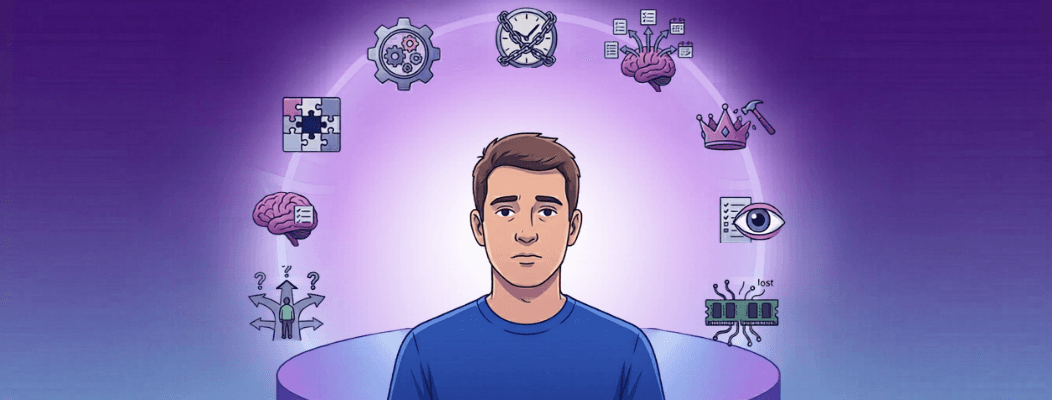
Think of your cognitive system as the brain's orchestration engine. Before you've consciously decided anything about a task, it's already running in the background: scanning for threat, predicting what the experience will feel like, weighing effort against likely reward, cross-referencing your past history with this type of work.
Cognition is not your feelings about the task - that's the emotional system. It's not whether you have energy - that's executive function. It's the coordination layer underneath both. And by the time you reach for the keyboard and find yourself thinking "I just don't feel like it," the orchestration engine has already run, and already returned a result you weren't consulted on.
That verdict is what we're unpacking here.
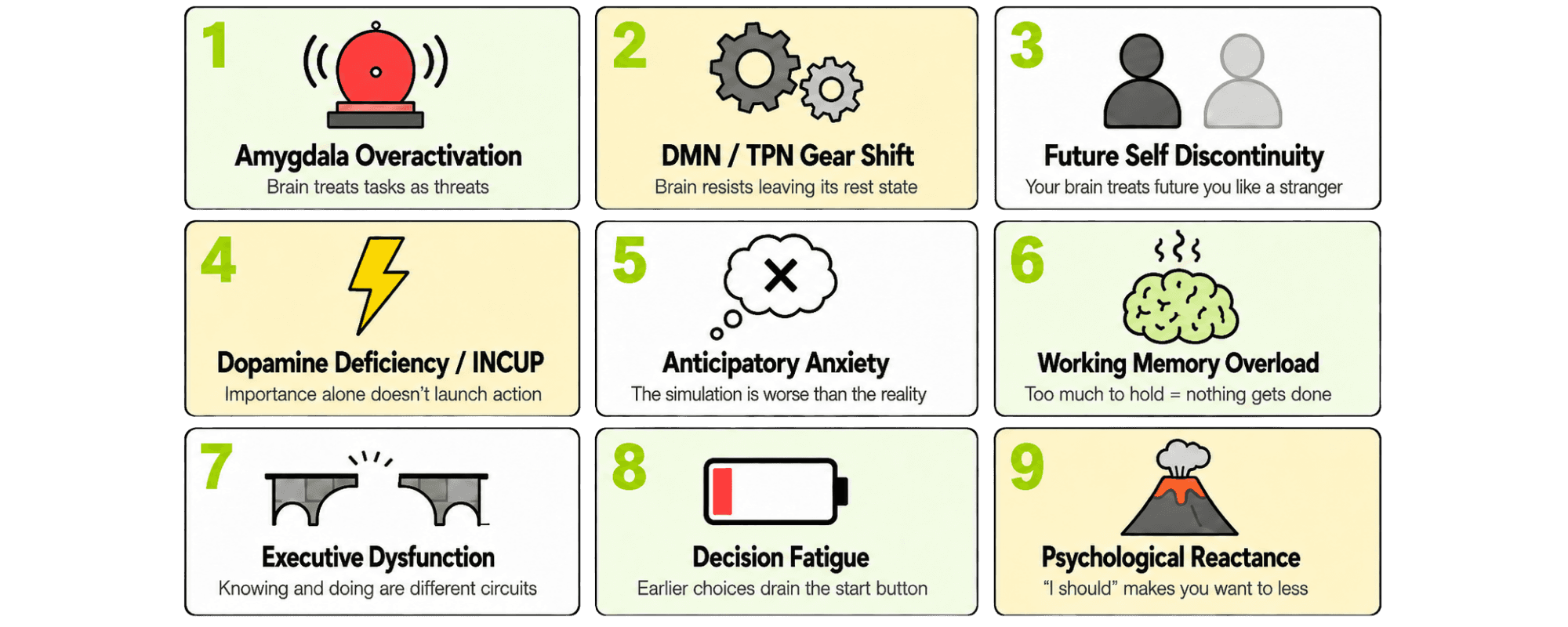
There are nine cognitive reasons why you struggle with getting started. And we're going to look closely at each of them.
1. Amygdala overactivation: Why your brain treats tasks like threats
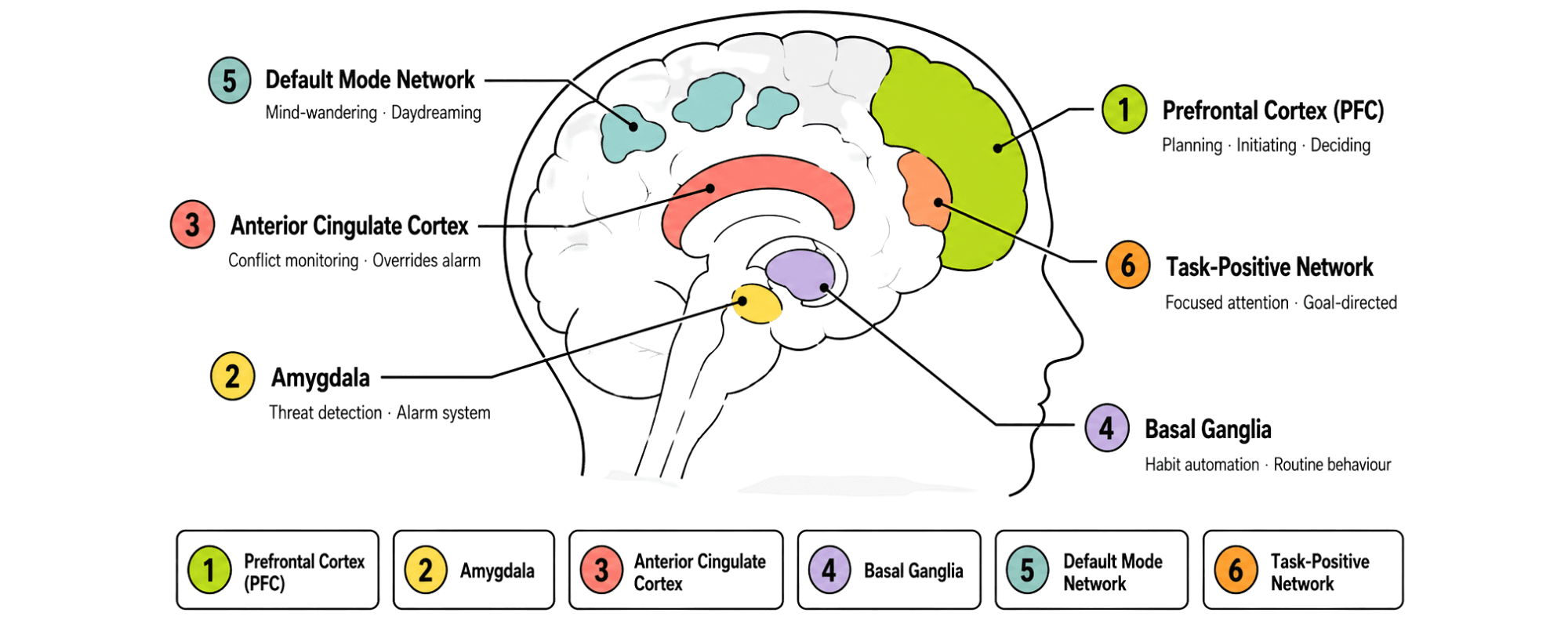
What's happening in the brain: Deep in the centre of your brain sits the amygdala - a small, almond-shaped structure whose job is to detect threats and sound the alarm. When it fires, your prefrontal cortex (the planning, reasoning, let's-actually-think-about-this part) is supposed to evaluate the signal and, most of the time, call it off. "It's fine. It's just an email. It's not a tiger."
But neuroimaging research tells a striking story about people who chronically struggle to start. They tend to have a larger, more reactive amygdala, and critically, weaker structural connectivity between the amygdala and the dorsal anterior cingulate cortex - the brain region responsible for overriding that alarm.
Plain version: the alarm fires just fine; it's the off-switch that doesn't work properly. So the alarm keeps going, and avoidance is the brain's only way to make the noise stop.
This is a wiring pattern. And it can be changed, but not by telling yourself to stop being scared.
How this shows up in everyday life: You open your email and immediately feel a vague dread you can't quite explain. You think about starting the presentation and your stomach drops, even though nothing catastrophic is at stake.
(I felt immediately anxious just writing this.)
You delay important phone calls, big decisions, or anything with real consequences, and then feel frustrated at yourself because logically, you know it's fine.
The signature is this: the size of the resistance doesn't match the size of the task. That mismatch is your amygdala speaking.
What to do about it:
The amygdala alarm is triggered by perceived threat, and the fastest way to reduce a threat response is to lower the stakes of the first action. Not the stakes of the task overall. Just the first thing you do.
Name it, tame it: Neuroscience research by Matthew Lieberman shows that simply labelling the emotion you're feeling (not suppressing it, just identifying it) measurably reduces amygdala activation. Saying "I notice I feel anxious about this" shifts processing from the reactive limbic system toward the more reflective prefrontal cortex. It's like you are telling your amygdala "I have received your danger warning message and I am keeping it in mind as I proceed forward." It sounds almost too simple but the data is there to support it.
The procrastination journal: Something that comes up repeatedly in r/ADHD and r/getdisciplined communities: keeping a simple log where every time you catch yourself avoiding something, you write down what the task was and what you felt in that moment. Not an analysis - just a record.
Over a few weeks, patterns emerge. People report realising they weren't avoiding a type of work so much as a specific feeling: embarrassment, boredom, fear of a particular person seeing it. Once you can name the actual trigger, "name it, tame it" stops being abstract. You know exactly what to name. (This same journal also helps with anticipatory anxiety - see section 5.)
The "do it badly on purpose" trick: One of the most consistently effective hacks people share in ADHD and procrastination communities is giving themselves explicit permission to produce terrible work. Better yet - the goal is to produce something of poor quality. On purpose.
Write the worst possible first paragraph. Design the ugliest possible slide. The amygdala's threat isn't about effort - it's about evaluation. By making "bad on purpose" the goal, you remove the thing the alarm is actually triggered by. And from bad, you can always iterate. From never starting, you cannot.
2. Default Mode Network vs Task-Positive Network: Why starting requires a brain gear change
What's happening in the brain: Your brain at rest isn't inactive. It's running something neuroscientists call the Default Mode Network (DMN) - a collection of regions that activate during mind-wandering, daydreaming, thinking about yourself, and imagining the future. It's a whole rich inner world. And your brain loves it.
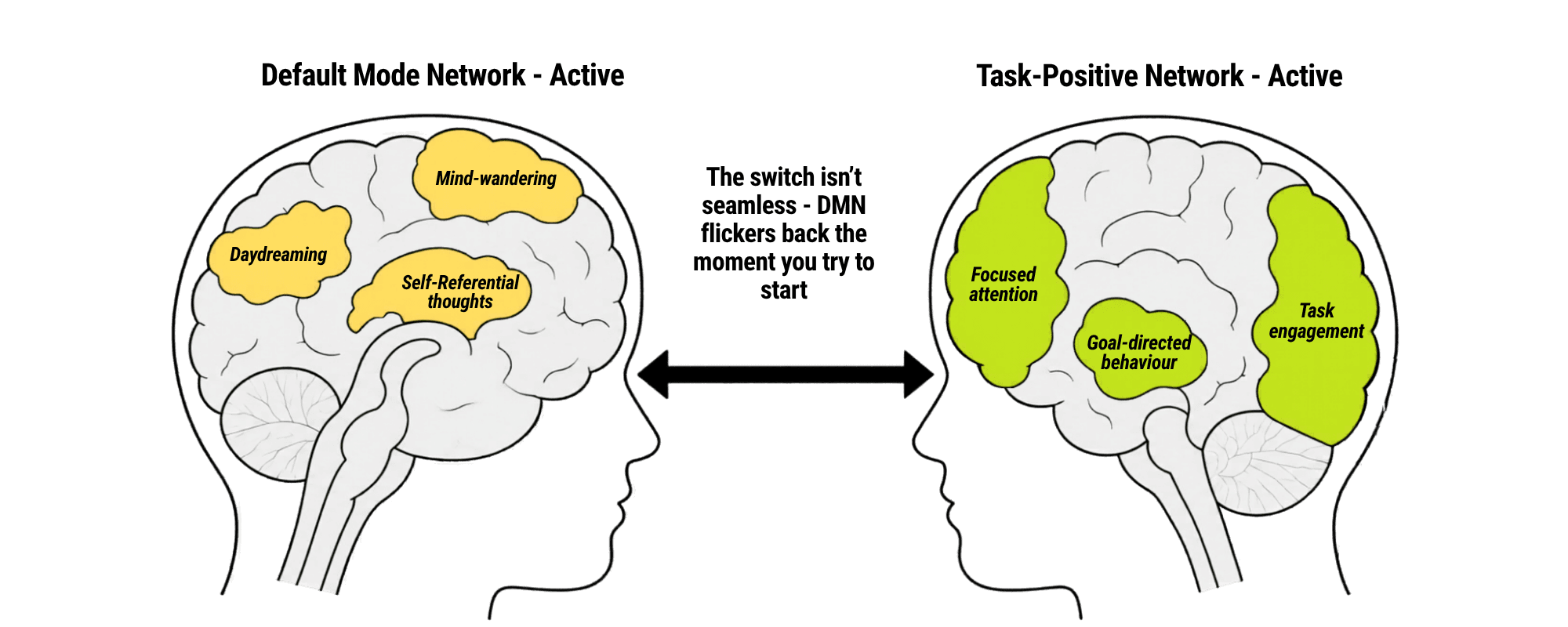
To do focused work, it has to switch to the Task-Positive Network (TPN). These two systems oppose each other - when one is on, the other goes quiet.
Here's the problem: the switch isn't seamless. Research shows the DMN actually flickers back on right when you try to start - as if your brain is double-checking whether it really has to leave. That's why beginning often feels like pushing through something. You're not imagining the resistance. You're interrupting your brain's preferred state, and it sure does like to put up a fight.
How this shows up in everyday life: You sit down to start. You check your phone. You remember something you meant to Google. You think about a conversation from earlier. You're not being distracted - you're in the DMN, and it hasn't released you yet. The drift back to low-stimulation activities (social media, email, wandering thoughts) is not weakness. It's your brain following its strong pull toward its default state.
What to do about it:
Since you cannot just get rid of the DMN-to-TPN switch, the goal is to build a bridge between the two systems.
Transition rituals: A consistent pre-work ritual - the same sequence of small actions done before you start - teaches the brain to associate those actions with the switch. Whether it's having a cup of coffee (this one is my fav!) or reading a book for a few minutes, the trick is to stay consistent long enough to condition yourself, just like Pavlov did with the dog. The more specific and consistent the ritual, the faster the switch becomes.
Physical pattern interrupt: One of the less commonly-cited strategies people swear by is using a brief physical intervention to force the network switch. Cold water on the face, ten jumping jacks, two minutes of movement. This isn't just "waking up" - it's using a genuine neurological state change to interrupt the DMN. Cold water specifically triggers a norepinephrine release, which is linked to increased alertness and task-readiness. The science is there if you can work up the courage to take a 30 second cold shower.
3. Future self discontinuity: Why your brain doesn't work for your future self
What's happening in the brain: UCLA neuroscientist Hal Hershfield ran a now-famous study in which participants were shown brain scans of themselves thinking about their present self versus their future self - and also about strangers. The finding was striking: thinking about the future self activated the same neural patterns as thinking about an unknown person. Not a close friend. A stranger.
This means that when you're deciding whether to do something whose benefits land in the future - work on your startup, exercise today, put money into savings vs spending it on a new shiny thing - your brain doesn't feel the future beneficiary is you. It treats them as someone else. And most of us don't sacrifice our weekends for years so that a stranger can have a cosy retirement.
Hershfield also found that individual differences in this future-self continuity predicted temporal discounting - how strongly you discount future rewards in favour of present ones. The weaker your sense of connection to your future self, the more present pleasures win.
How this shows up in everyday life: You genuinely want to do something - lose weight, finish a creative project, learn something new - but when it comes to the specific Tuesday evening where you'd actually have to do it, the motivation evaporates. You're not lazy. You're doing something rational: choosing present you over a stranger’s future.
What to do about it:
The goal is to increase felt continuity with your future self - to make them feel less like a stranger and more like a close friend.
Write a letter from your future self: This might sound childish but the research behind it is real. Composing a message from the version of you who did (or didn't) follow through activates the same neural empathy pathways that normally kick in for people we care about. It increases future-self identification measurably.
Third-person self-talk: Research by Ethan Kross at the University of Michigan shows that referring to yourself in the third person when facing a difficult task, e.g., "[Your name] needs to do this now," creates psychological distance from the anxiety and simultaneously increases follow-through. It works because it creates the same self-distancing that makes the future self feel like a separate, real person you can care about. Not to mention that it creates structure and clarity that people who struggle to get started often rely on others for.
4. Dopamine deficiency and the interest-based n ervous system: Why important tasks don't motivate you
What's happening in the brain: Most people assume motivation follows importance: the more something matters, the easier it should be to start. For a lot of people, that's just not how it works.
Psychologist Dr. William Dodson identified a different motivational system that many brains actually run on. Instead of importance, it responds to: Interest, Novelty, Challenge, Urgency, and Passion - INCUP for short. It's most common in people with ADHD, but it also shows up in people running on chronic stress, burnout, or anyone whose brain is naturally wired toward novelty-seeking.
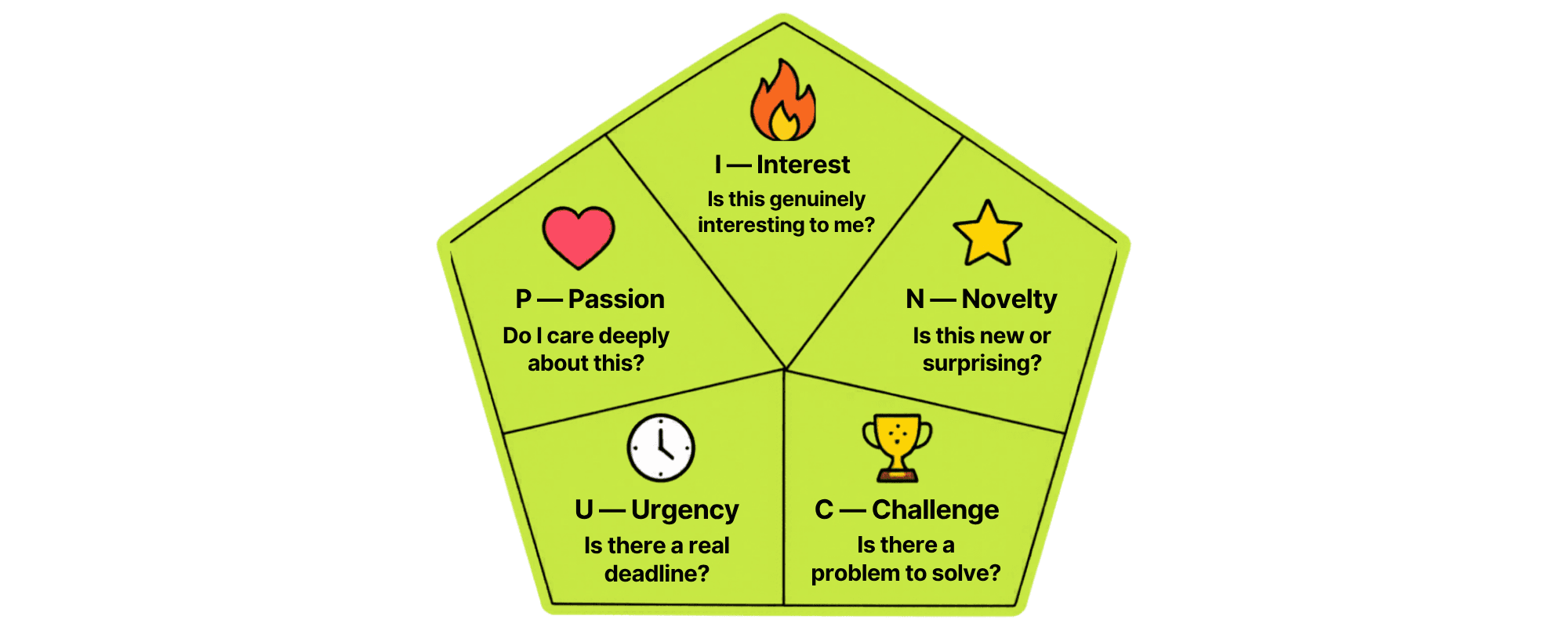
The chemical behind this is dopamine. Best known as the pleasure chemical, for these types of people it is the initiation chemical. When a task is boring or routine, dopamine doesn't fire strongly enough to get you moving. When a task is interesting, urgent, or novel, it does. The importance of the task is almost irrelevant to this system. The interest is everything.
How this shows up in everyday life: You can spend four hours researching a topic you're fascinated by and then cannot summon the energy to do a chore. You finish a video game in a weekend but lose momentum on a project you actually care about after an hour. You function brilliantly when a real deadline is approaching and feel frozen when it's distant. This pattern maps directly onto INCUP.
What to do about it:
You can't always make a task interesting. But you can often inject one element of INCUP into almost anything.
Deliberately manufacture one INCUP factor: Do the task in a different location (Novelty). Race yourself against a timer (Challenge). Tell someone else your fake deadline (one that's earlier than the real one), and let the social accountability create Urgency. Play a soundtrack you associate with deep focus (not quite Interest, but a sensory trigger that helps).
Dr. Dodson himself recommends having 60-100 different strategies that can be rotated, because novelty wears off. The trick that worked last month may not work this month, and that's expected. Creating new strategies might just spark your interest and become a challenge of its own.
The forbidden pleasure: This is a play on Katherine Milkman's "temptation bundling" concept: designate one enjoyment as exclusively available during a specific task. Not as a reward after. Not as a break. Only during. Your favourite podcast only plays while you're doing admin. That show you're obsessed with only runs when you're on the treadmill. The key is the conditionality - if you don't do the task, you don't get the pleasure. Milkman's research showed gym attendance increased 51% with this approach.
I swear by this one myself. My favourite podcast comes out twice a week and I go on long walks on those days, regularly hitting my 7k+ steps goal.
5. Anticipatory anxiety and learned avoidance: How your brain gets trained to procrastinate
What's happening in the brain: This one is a bit technical but bear with me. There's a region in the brain called the anterior cingulate cortex that generates anticipatory anxiety - meaning it fires before you've even started.
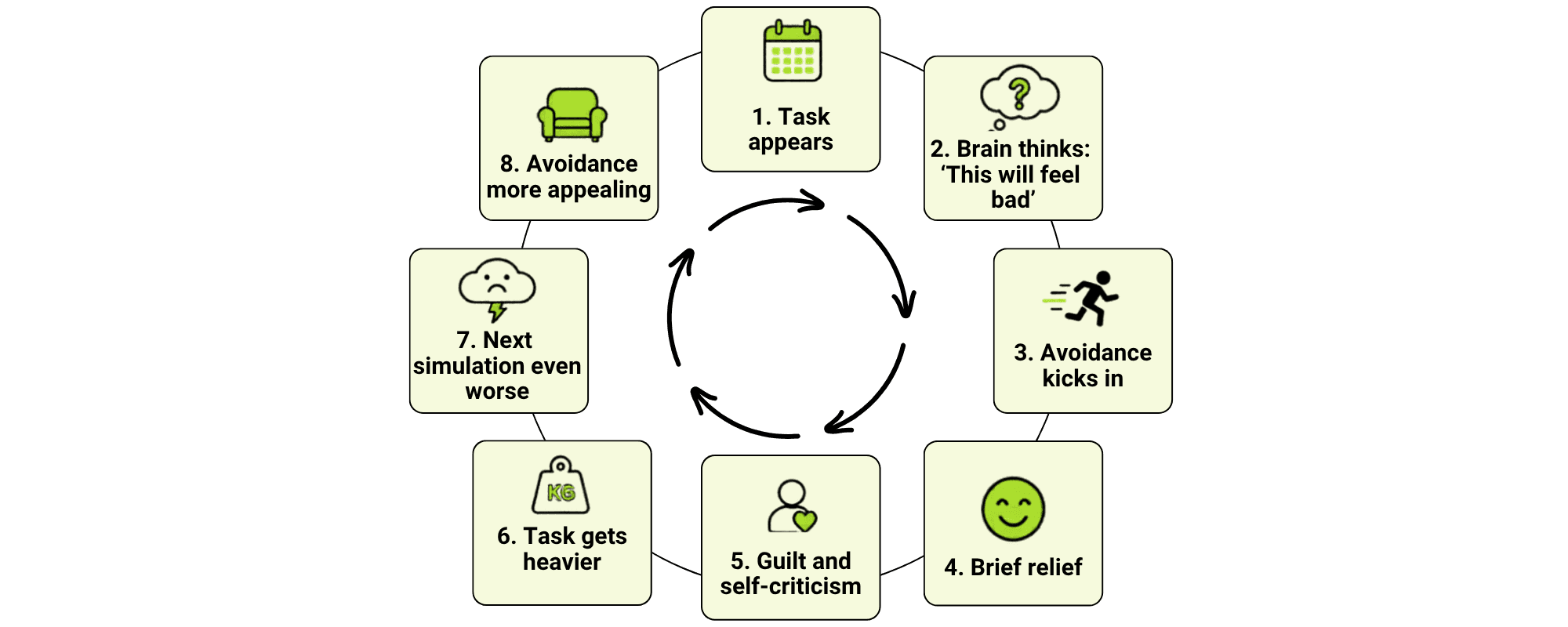
When you think about a task you've previously found unpleasant, your brain runs a quick simulation of what it'll feel like. If the prediction is "uncomfortable," the task gets flagged as a threat. You haven't touched the work yet, but the dread is already there.
Here's where it gets self-reinforcing. You see the hard task and you avoid it, procrastinate. Avoiding a threat creates relief and it genuinely feels good. But then comes the guilt. You tell yourself you really need to do this, you're being lazy, and you have to start now. That pressure makes the task feel even more loaded than before. So the next time you think about it, your brain has logged both the original discomfort and the guilt spiral on top. And avoidance looks even more appealing. The loop tightens every time you go around it.
Research by Dr. Fuschia Sirois at Durham University adds one more piece: we reliably overestimate how bad tasks will feel to do, and procrastination-prone people overestimate even more dramatically. The simulation the brain is running is inaccurate. The task will almost always feel less awful once you've started than it felt in anticipation. The fear is a forecast. And just like the weather forecasts often are, it's wrong.
How this shows up in everyday life: You feel dread before opening a document you've been avoiding, then once you're in it, you're fine. You catastrophize about a conversation until you have it, and it's half as bad as you expected.
What to do about it:
The goal here is to shorten or bypass the "before" - either by entering the task faster than the anticipatory anxiety can fully build, or by explicitly updating the brain's forecast.
The 5-second launch: Mel Robbins' popularised version of this: count backward from five and physically start moving before the anticipatory response can build. This technique has genuine neurological backing. Anticipatory anxiety takes time to ramp up. A fast physical start (literally standing up, opening the laptop, picking up the pen) can beat the anxiety to the door.
The 30-second rule: The moment you sit down at your desk, you open the avoided task before you do anything else. No email check, no settling in, no phone. Straight to the thing. The logic is exactly what neuroscience suggests: the anticipatory anxiety window needs a moment to open. If you're already in the document before that moment arrives, the simulation never fully runs.
I've been using this rule for years (without knowing its name) when I go swimming. I've learnt to just go straight in. Otherwise, I stand and slowly step by step get used to the water, which could take up to 30 minutes. So I adopted this technique.
This is similar to Brian Tracy's "Eat That Frog!" - only you have to explicitly start straightaway after opening your computer; no delay whatsoever. For me, it works really well, just like with the swimming.
6. Working memory overload: Why big tasks freeze your brain before you begin
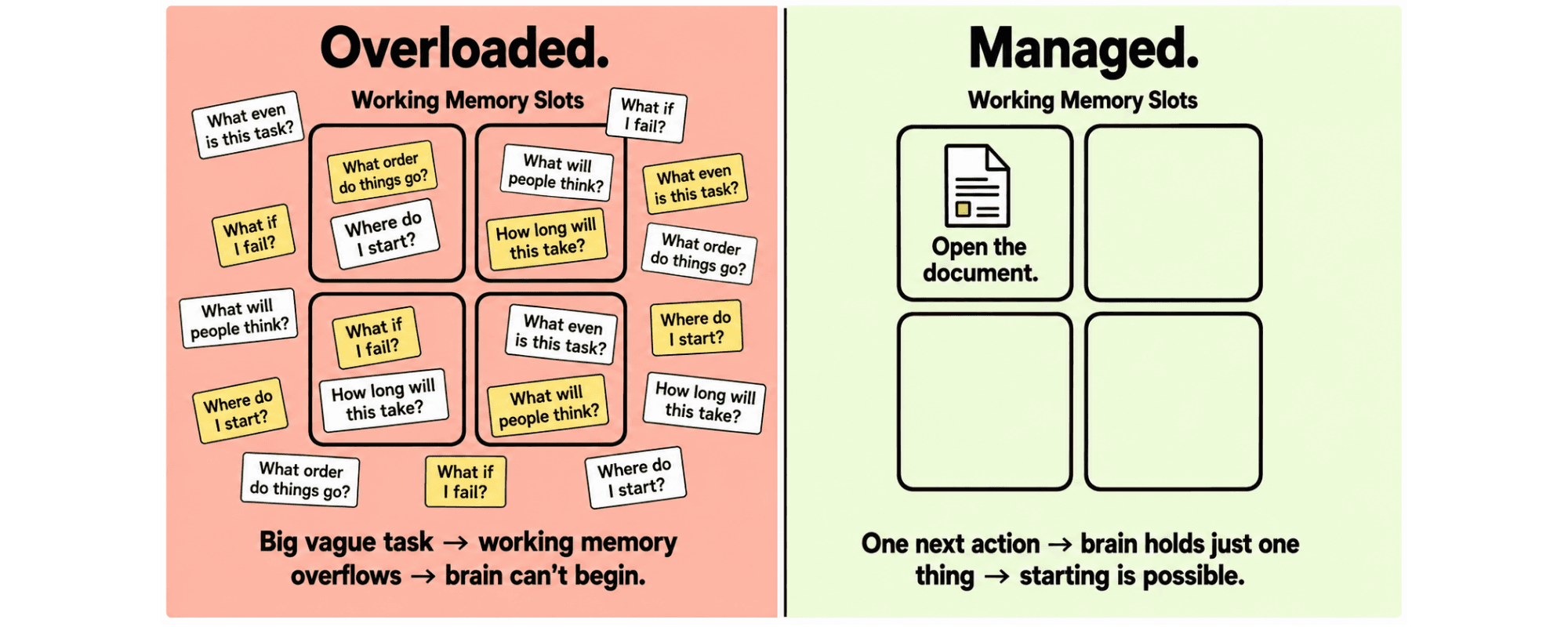
What's happening in the brain: Working memory is your brain's short-term scratchpad, the space where you hold information while you're actively using it. It's small. Most people can hold around four things in it at once, and only for a few seconds before they fade. (This is why multitasking is so hard for many.)
When a task is big or vague, your brain tries to load the whole thing onto that scratchpad at once: what it is, how to do it, where to start, what could go wrong. The scratchpad cannot handle all of this at once, hence it overflows. And when it can't hold the full shape of the task, it can't begin it.
This is why big vague tasks, e.g., "work on the book," "sort out my finances," are so resistant to initiation. The brain is not being asked to do them; it's being asked to hold them in working memory and figure them out simultaneously, while also managing any emotional response to them. That's too much to carry.
How this shows up in everyday life: You sit down to work on something big and your mind immediately goes blank. You don't know where to start, not because you don't know the goal, but because you're trying to hold too many variables at once. Imagine carrying your weekly grocery shop in your hands. No bags. Of course things fell down and spread around. Result - you feel overwhelmed before you've done anything.
What to do about it:
The solution is not to motivate yourself through the overwhelm. It's to reduce what working memory is being asked to hold.
Externalise the task structure: Writing out the task's sub-components onto paper or into an AI goal breakdown app offloads them from working memory. Your brain no longer has to hold all the pieces - it just has to know what the next one is. This is why well-designed task breakdown tools aren't just organisation systems - they're literally extending your brain's working memory capacity.
The smallest possible entry point: The single most reliable hack is also the most scientifically grounded: make the first action so small it barely registers as a task. Not "work on the report" but "open the document." Not "exercise" but "put on shoes." Once you're in motion, the working memory load of continuing is far lower than the load of beginning. The hard part is the launch, and the launch can be almost nothing.
Many people on Reddit swear by this one, but if I am honest, I am not the biggest fan of tasks like "Pick up the pen" - they seem too small for me, and sound almost gimmicky. But something like "Write the first paragraph" feels achievable: not so big as to cause overwhelm, and not so small that it feels like I am tricking myself. So the bottom line is - find the size of the task that works for you and build a list of tasks for achieving your goal.
7. Executive dysfunction and the intention-action gap: When knowing what to do isn't enough
What's happening in the brain: Dr. Russell Barkley describes ADHD as "a disorder of doing what you know, not knowing what to do." The gap between knowing you should start and actually starting is a neurological one.
Task initiation draws on a set of executive functions. Think of them as the cognitive skills that sit between having an intention and acting on it: planning, prioritising, initiating, and holding the goal in mind long enough to actually move toward it. They're housed primarily in the prefrontal cortex, and they run on dopamine and norepinephrine.
When those chemicals are in good supply - after solid sleep, under low stress, when a task is genuinely interesting - the circuit from intention to action connects smoothly. When they're depleted, the circuit breaks. Think of a drawbridge that's opened to let a ship through and hasn't closed back down yet. You can see the other side clearly. You know exactly where you're going. But the bridge isn't down, and you can't cross.
Chronic stress makes this worse: cortisol progressively dials down prefrontal cortex activity, which means the longer you're under pressure, the harder it gets to override the avoidance impulse; not because you've stopped caring, but because the chemistry to do so isn't there.
How this shows up in everyday life: "I know exactly what I need to do. I just can't make myself do it." Sitting in front of the task, fully aware of what's needed, and experiencing a complete gap between intention and movement. Some people report having a bizarre sensation of watching themselves not do the thing, as if from outside.
What to do about it:
This is the failure mode that requires external scaffolding. When the internal circuit isn't firing, you need something outside you to bridge the gap.
Body doubling: The practice of working alongside another person - physically or virtually - is one of the most consistently effective interventions for this specific failure mode. It works not through accountability in the way most people think, but through the social nervous system. The presence of another person activates a different neural pathway, one that runs on social engagement rather than executive function. Research on virtual body doubling has shown completion rate improvements of around 40%.
Narrating out loud: Saying what you're about to do, out loud, in the room, e.g., "I'm going to open the document now," engages the verbal processing system, which is better at self-regulation than the internal narrative that's currently frozen. It sounds unusual and it is. But when internal self-regulation has stopped working, using the verbal system as a workaround is a genuine strategy.
My mom has been doing this ever since I remember (as a means to remind herself of the next step) and I tend to do this when I get distracted as well as frozen to steer myself in the right direction. And it always works.
8. Decision fatigue: How too many choices before you work make starting impossible
What's happening in the brain: Every decision draws on prefrontal cortex resources, cumulatively. Research shows that self-control and decision-making share a finite cognitive resource, and that resource depletes over the course of a day.
The decision to start is itself a decision. So is the decision how to start, and in what order, and on which part. By the time many people sit down to work, after a morning of emails, messages, requests, and choices, the prefrontal cortex has already been working on full power. Starting feels harder not because the task is harder, but because the resource is lower.
How this shows up in everyday life: Starting feels harder as the day goes on, even when you have more time. Your plan written the night before dissolved in the face of chores, emails, calls, and interactions you had to do in the morning. By the time you sit down to work on your to-dos, you feel depleted, and starting feels 10 times harder than it would have done had you had the morning resources.
What to do about it:
The goal is to make as few decisions as possible before the work begins.
Pre-decide everything the evening before: Not just tomorrow's to-do list, decide on the specific first action you'll take at the specific time you've assigned. "At 9:15, after coffee, I will open the presentation and write the headline for slide 3." The decision has been made. The morning-you arrives to a cleared runway. This is essentially a pre-commitment device that bypasses the decision-making cost entirely.
Structured procrastination as decision architecture: Stanford professor John Perry's "structured procrastination" principle has a devoted following in productivity communities. The insight: put a more important, more frightening task at the very top of your list. You'll procrastinate on it by doing everything else on the list, including the things you were originally trying to avoid. Your avoidance instinct becomes productive. It works because the decision about what to do has been made by the structure of the list, not by you in the moment.
9. Psychological reactance: Why "I should do this" makes you want to do it less
What's happening in the brain: Psychological reactance is the brain's response to perceived threats to autonomy. When you feel that your freedom to choose is being constrained - paradoxically, even by yourself - you tend to experience a motivational rebound toward exactly what's being restricted.
This is why to-do lists can backfire. The moment a task is formalised as a "should," it acquires a coercive quality. The task was neutral or even desirable before it was written down; now it's an obligation, and part of your brain wants to resist it.
Self-Determination Theory research confirms that externally regulated goals (even when the "external" is your past self who made the list) produce weaker engagement and higher abandonment rates than intrinsically motivated ones.
How this shows up in everyday life: Things feel harder once they're on the list. You feel resentment at your own to-do list. You avoid doing exactly the things you've committed to most publicly. You're mysteriously good at tasks that aren't "yours" to do, e.g., helping a friend, tackling something spontaneous, while paralysed on your actual priorities.
What to do about it:
The goal is to reduce the coercive quality of the task by re-establishing a sense of choice.
Reframe the language of the task: "I have to write this" generates resistance. "I'm choosing to write this because I want what it leads to" reduces it. This is cognitive reappraisal, which has genuine effects on prefrontal cortex regulation of the limbic system. Small language shift, real neurological difference.
The forbidden task inversion: A counterintuitive approach that multiple Reddit users have landed on independently: mark the task as off-limits. "I'm not allowed to write the report yet." By removing the obligation framing, you reduce the reactance. Several people describe this as the only thing that got them to start something they'd been avoiding for weeks. The moment it became forbidden rather than required, they wanted to do it. This directly exploits the reactance mechanism - using the brain's tendency to want what it can't have in your favour.
Find the hacks that work for you
If you read through all nine of these and noticed that some of the advice seems to contradict itself - you're spot on.
One of the hacks is to create a ritual before you begin a task, the other says to jump into the task without a pause. One says write a list, the other one says that lists make your brain resist the task.
That's not a mistake in the research. It's the honest reality of the cognitive dysfunctions that make getting started so hard.
I've tried all of them. Not all of them have stuck. Some worked immediately and then stopped working after a few weeks. Some felt completely wrong for my brain, so I didn't even bother to try them for even a few days.
Everyone has their own unique combination of cognitive factors, likely on top of the emotional, environmental, etc. reasons, so the only way to find out what will work for you is to try out a method for a few days or weeks depending on how well or badly it works for you, and then stick to the most successful one until you create a habit. Then add another one or two to create a system that works to help you achieve your goals.
Try the Luumer diagnostic quiz to find out what prevents you from getting started - it's a faster way in than reading everything and determining which systems, apart from the cognitive, fail you.
Explore how Luumer helps you turn these insights into actual next steps: luumer.com