Task paralysis: what it is, why it happens, and how to deal with it
Olya Zaplatynska
Last updated:
I still remember where I was when I first came across an article about task paralysis. For me, it was one of those almost cartoonish moments when music plays, light floods in, and the puzzle finally comes together.
For most of my life, I attributed my frequent inability to get started to the fact that some people are good at starting things, while others are good at continuing. So figured I belonged to the second half. Plus, I really am good at maintaining established routines.
I understood procrastination and sometimes was guilty of it: pushing something unpleasant off because it was unpleasant, dragging my feet on something hard when I was running low on energy. I knew that feeling.
But sometimes I'd hit something different. A wall. A freeze. A complete inability to move on to a task I actually wanted to do. I'd find myself sitting there, overwhelmed and stuck, and I couldn't explain why. It wasn't laziness either. I always suspected there was something more going on.
So I decided to spend time going down a rabbit hole of why starting sometimes feels so hard in the first place. Then, one day, while reading about ADHD, I came across an explanation of task paralysis, and suddenly everything made sense.
If you're still mapping the broader picture of why you struggle to get started, you might want to start with an article that covers the five core mechanisms behind not being able to get started and what to do about each one.
If you already know you struggle with task paralysis, read on to learn the science behind it, how it shows up in real life, and practical, everyday hacks to break out of it.
What is task paralysis?
Task paralysis is the state of knowing exactly what you need to do - and being completely unable to start.
You want to. You just can't.
You feel stuck. Paralyzed and weighed down. Even sometimes lost.
It's a neurological freeze response, and it has surprisingly little to do with how much you care about the task. Actually, it tends to hit hardest on the things that matter most.
The difference between task paralysis, procrastination, and laziness
People with task paralysis often think they are lazy or procrastinators. So let’s get clear on the distinction right off the bat.
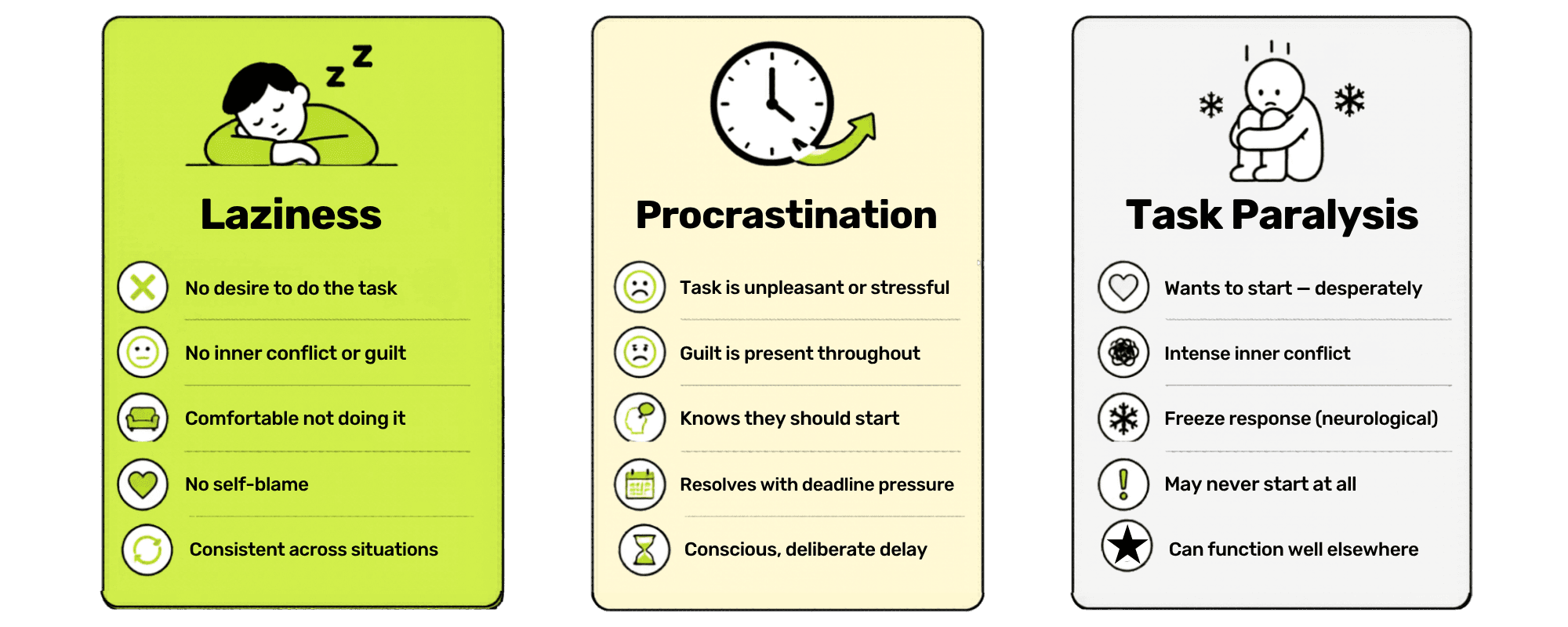
Laziness is the simplest to separate. A lazy person doesn't particularly want to do the task, and they're fine with that. They don’t feel an internal conflict; there’s no guilt or shame. Just a quiet "not worth my energy."
Procrastination is harder to distinguish, especially from the outside. Both task initiation paralysis and procrastination involve not starting. But procrastination typically involves a task that's unpleasant, uncomfortable, or stressful in some specific way.
Something you dislike doing, something that stresses you out, something physically hard when you're running low. You consciously put it off, you know you should be doing it, and you feel guilty. Eventually, with enough deadline pressure, you start.
Task paralysis is a freeze in front of something that feels threatening. It can be a goal so large it seems impossible to begin. Or a project where failure feels inevitable because you have already failed in the past. Or it can be a dream so vague, you can't even find the starting line.
You're not choosing to avoid it. You want to start, often desperately, but your mind and body simply won't move.
You're not doing something else instead. You're doing nothing. And the nothing feels unbearable.
Another way to distinguish task paralysis from procrastination is by considering duration.
Procrastination usually resolves: the deadline arrives, the pressure builds, and you eventually start.
Task paralysis can mean you never start at all. The thing that freezes you is often a dream you've carried for years. The dream isn’t delayed. It’s been quietly canceled by years of not moving.
What triggers task paralysis?
I think it’s important to understand what's happening neurologically when you have task paralysis. Knowing the science might seem boring and pointless, but it does something important: it removes self-blame by showing that task paralysis is a brain state, not a character flaw.
Stress
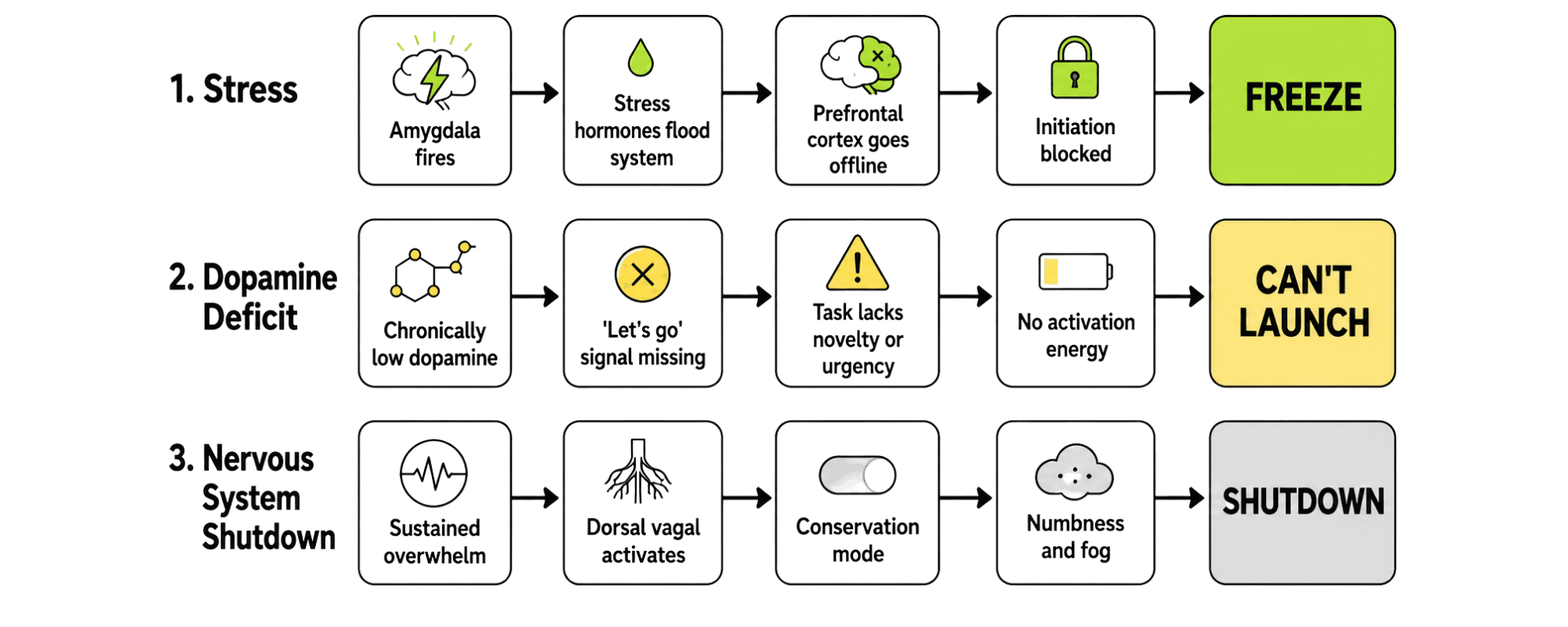
Your prefrontal cortex (PFC) is the part of your brain that plans, initiates, and makes decisions. When you're calm, it's online.
When your brain perceives something as a threat (even a psychological one), your amygdala fires. Stress hormones flood the system.
Research at Yale shows that even mild stress can take the PFC offline, weakening the neural connections you need for conscious self-control.
The more threatening a task feels, the less access you have to the part of your brain that could actually start it.
If you want to go deeper on the cognitive mechanics of why the brain treats certain tasks as threats, the article "9 cognitive reasons why you can't get started" breaks that down in detail.
Dopamine deficit
For many people, particularly those with ADHD, task paralysis has a different trigger: not enough dopamine to initiate action.
Dopamine is the brain's "let's go" signal, the chemical that tells you this is worth doing, begin. Kind of like putting fuel in your car to get the engine running. No fuel, no revs.
Research shows that ADHD brains have chronically lower dopamine, particularly when it comes to tasks that aren't novel, urgent, or emotionally charged. This dopamine deficiency is why someone with ADHD can spend six hours hyperfocusing on something they love, without noticing the time fly by. But when it comes to writing a work email, they stare at a screen for 40 minutes.
ADHD paralysis has nothing to do with task difficulty. It's entirely about whether the brain has enough neurochemical activation energy to launch.
Nervous system shutdown
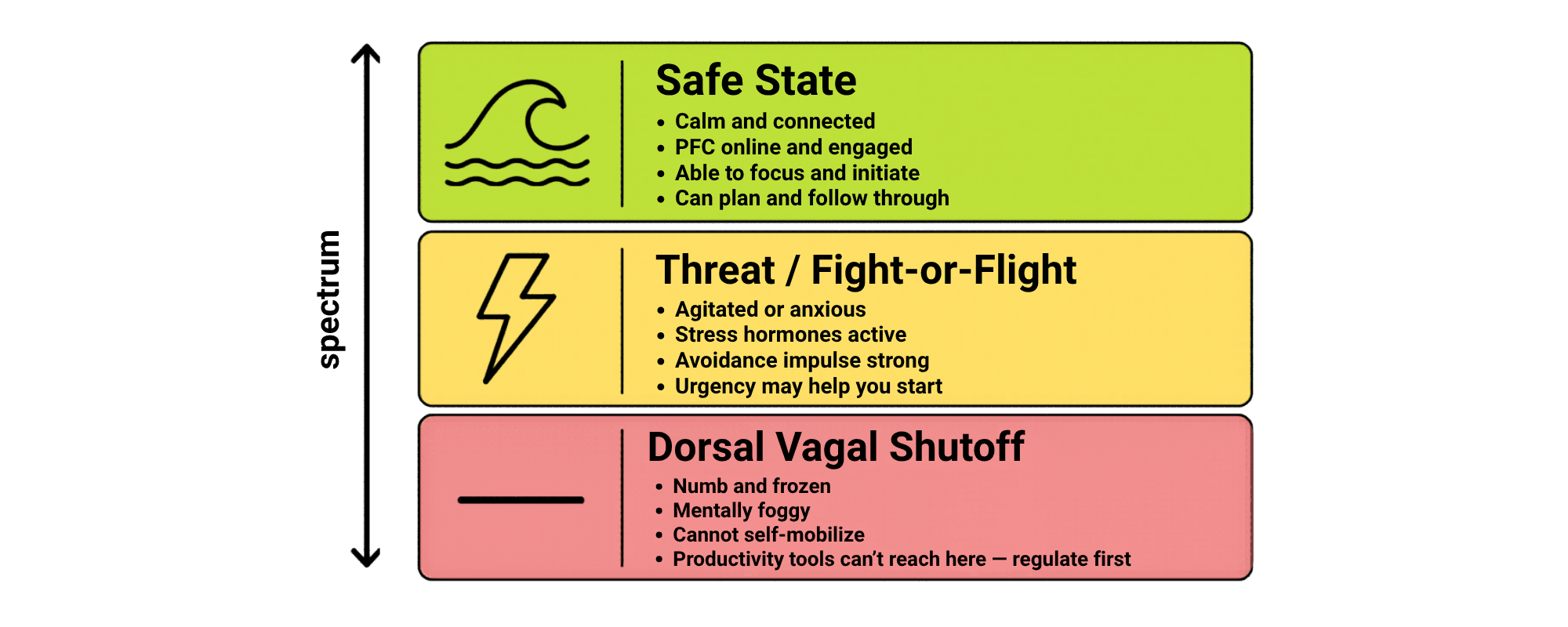
Polyvagal Theory, developed by Dr. Stephen Porges, describes three nervous system states.
The safe state: calm, connected, able to engage.
The threat state: fight-or-flight.
And a third, less discussed state: dorsal vagal shutdown. Numbness. Mental fog. A flat, frozen inability to self-mobilize.
Your body enters a physiological conservation mode, the same ancient mechanism that makes a cornered animal go limp and play dead. And when you're in that state, productivity tactics don't reach you. The nervous system has to come back online before anything else can work.
Some scientists are skeptical of Polyvagal Theory's clinical applications, and these critiques are worth taking seriously. But as this is my main trigger and the hack that works to conquer my task paralysis is the nervous system reset, I thought it was worth mentioning this trigger, as many people relate to it.
Mental health issues
Unfortunately, task paralysis rarely shows up alone. It is often diagnosed alongside ADHD, anxiety disorders, depression, perfectionism, and burnout. These conditions reinforce each other in ways that make self-diagnosis practically impossible. And even with specialist treatment, the correct diagnosis can take years.
If task paralysis is significantly affecting your daily life, a professional can help you work out exactly what you're dealing with. Just be prepared for it not to happen overnight.
The lines between these conditions are genuinely blurry, and knowing which ones affect you in which ways is important for healing.
How task paralysis shows up in your life
Whether you are at work, struggling with self-started projects, or even if it relates to your personal relationships, there is a common thread in task paralysis: you know you need to, you want to, but you can't bring yourself to start
Here are just a few examples of how task paralysis shows up in day-to-day life:
Sitting in front of an open document for an hour and writing nothing
An important email that's been in drafts for days
A project you care about deeply that lives entirely in your head and never makes it into the physical realm
Conversations you keep postponing until the moment has passed
It also includes sophisticated procrastination: hours of research, planning, reorganizing files, and reading about the task. The activity looks productive. But if the guilt is underneath it, if you're still waiting for the real work to begin, that's task paralysis too.
What it's not
Task paralysis is not choosing to rest. There's no relief in it.
Time passes and feels wasted and shameful, not restorative. It's not a sign of laziness or lack of capability.
And it's not consistent. You can function perfectly well in one area of life and be completely frozen in another. For example, you can climb up the ranks at work as a software engineer, and not be able to create a website for your dream consulting business.
Stuck in a loop: why task paralysis gets stronger, not weaker
The hardest and saddest truth about task initiation paralysis is that it’s self-reinforcing. Meaning you are stuck in a loop, and the longer you stay in it, the stronger it gets.
It can seem like enough willpower and effort would be enough to push through. But that's a fundamental misread of what's happening. Once you’re in a loop, it has to be interrupted and dismantled.
The avoidance loop
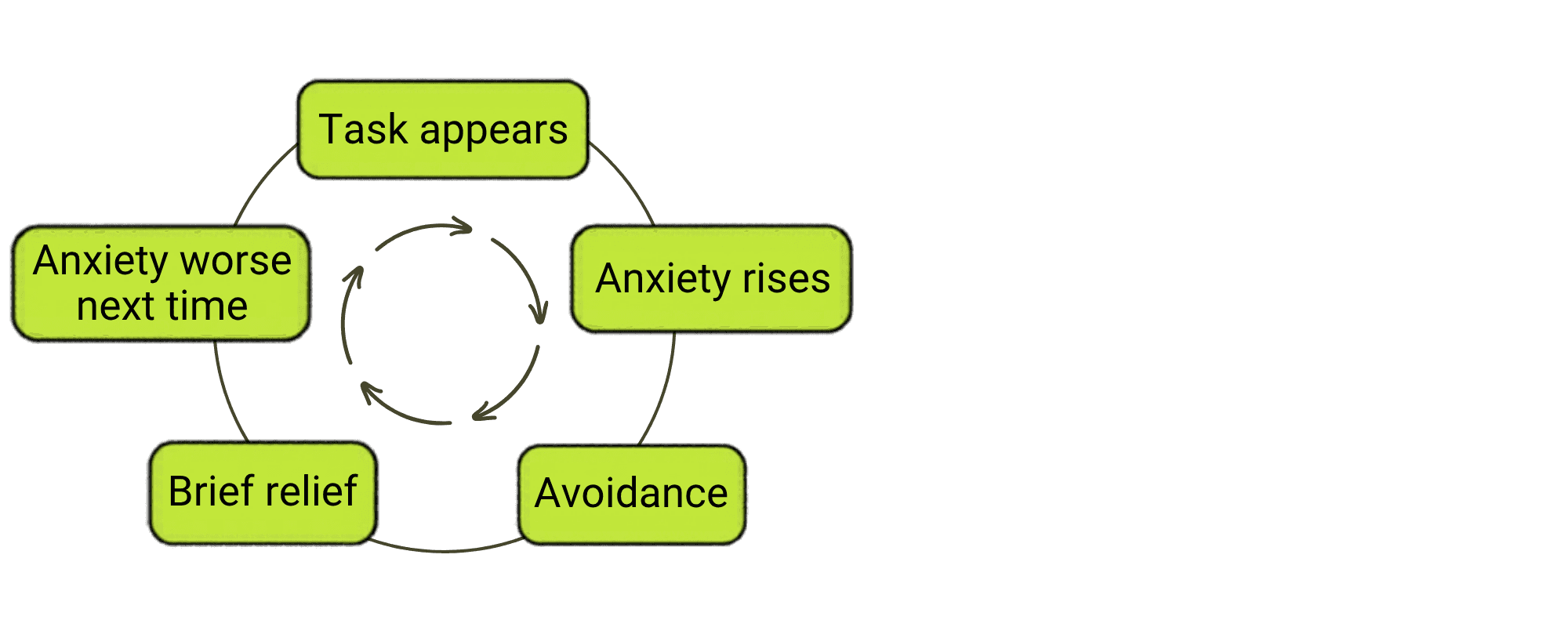
You have a difficult task. Anxiety rises the moment you think about it.
So you avoid it. Brief relief follows. Your brain registers: avoidance worked, avoiding made me happy (relieved).
But the task didn’t disappear, so the next time you think about it, the anxiety raises its ugly head even faster, and you feel even more frozen.
Repeat.
The shame spiral
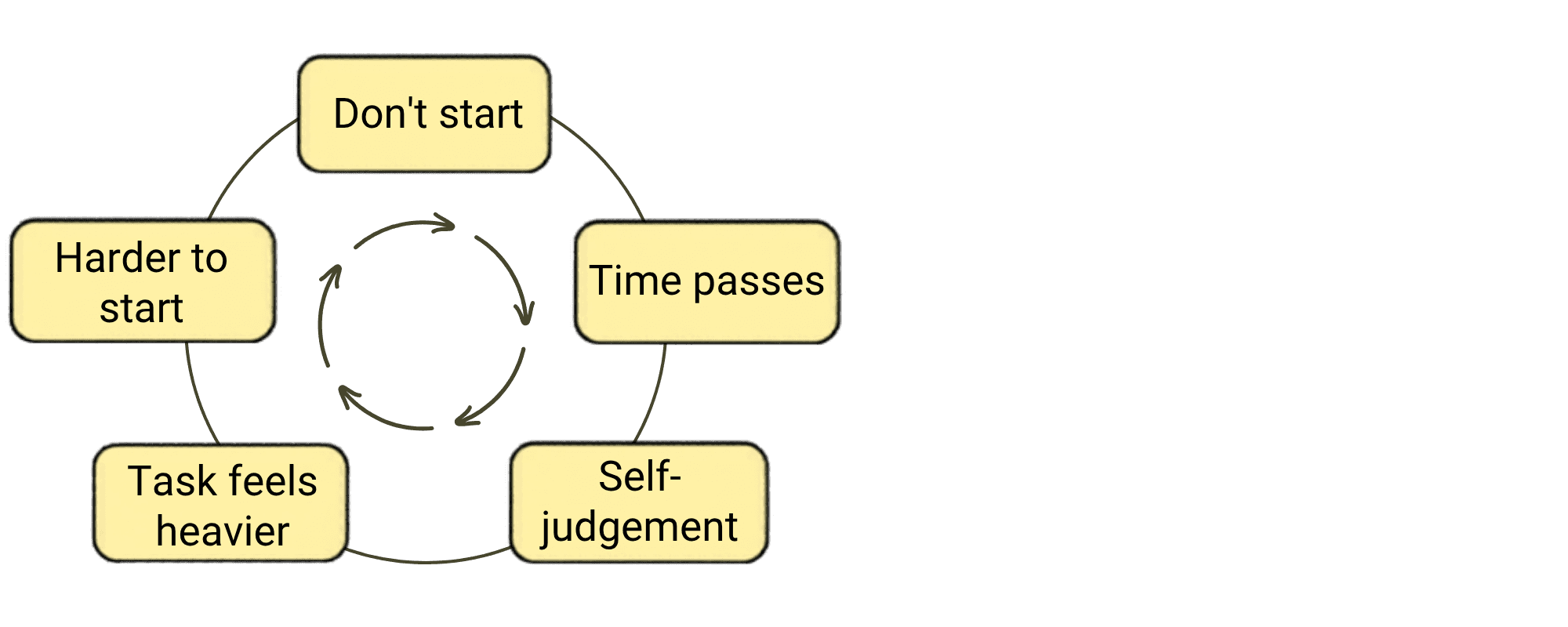
You don't start. Time passes. You judge yourself.
The self-criticism adds weight to the original task.
The heavier the task, the harder it is to start.
More time passes. More shame.
Repeat.
The perfectionism loop
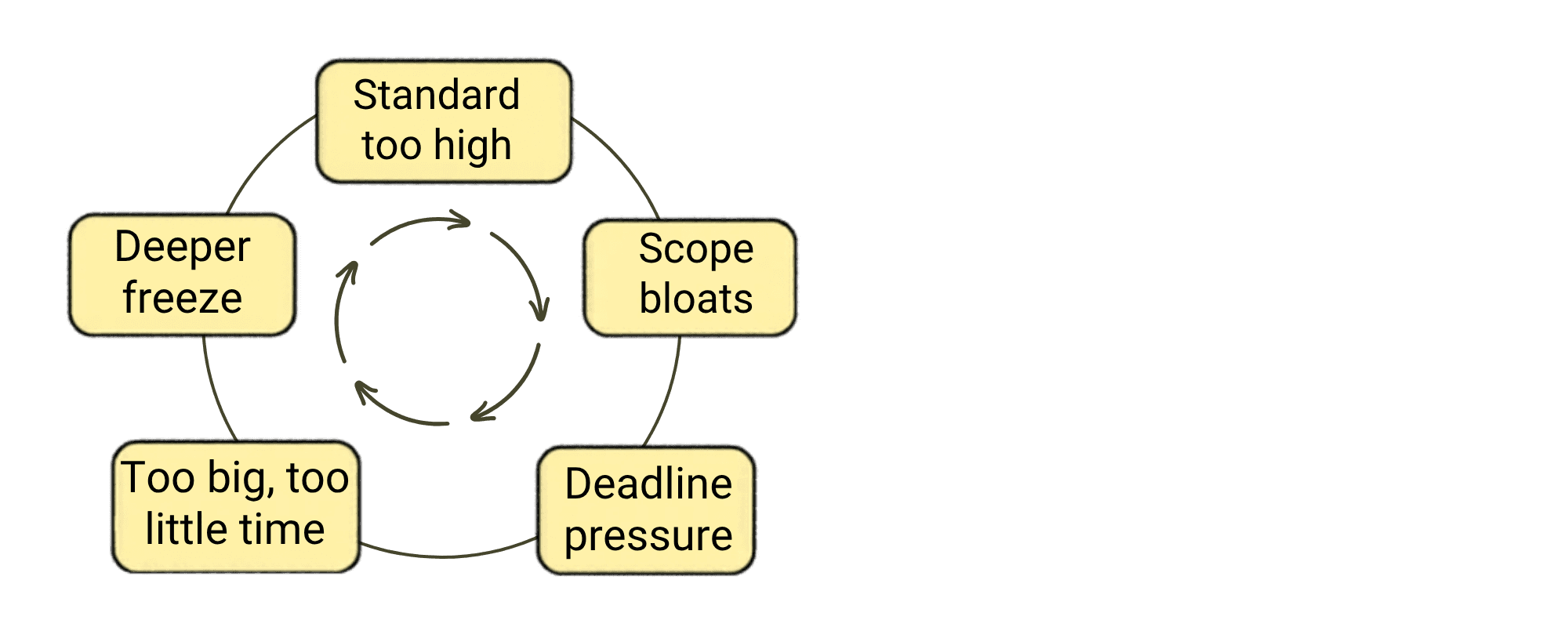
Perfectionism sets an impossible standard. The task grows out of proportion because making every step perfect takes a lot of time and effort.
The scope bloat. The threat of falling short is enough to trigger freeze.
Time pressure mounts. Now the standard has to be met fast. But the scope is still huge.
Deeper freeze.
The identity loop
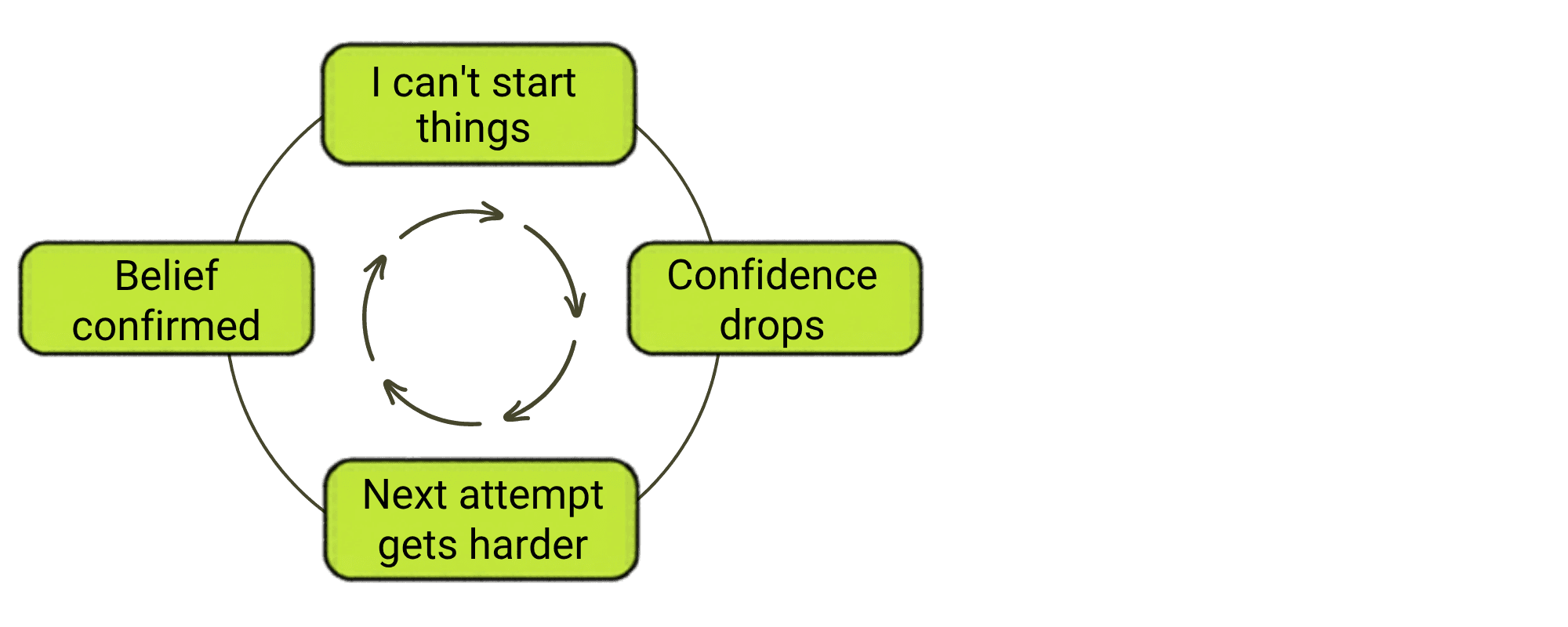
Repeated paralysis starts to feel like evidence. "I'm someone who can't start things."
That belief lowers confidence for the next attempt, making it harder, which in turn confirms the belief.
Repeat.
These loops can be broken through interruption and dismantling, not effort. So let’s move on to the most important part - how to unfreeze yourself.
Scientifically backed ways of overcoming task paralysis
Cognitive Behavioral Therapy (CBT)
What it is: A structured therapeutic approach to identifying and challenging unhelpful thinking patterns.
How it addresses task paralysis: CBT targets the distortions that feed the loops: catastrophizing, all-or-nothing thinking, and the beliefs that make tasks feel more dangerous than they are. It works on the loops at their source by changing how threatening the task feels rather than just managing the resulting freeze.
Evidence: A 2018 meta-analysis by Rozental et al., covering 17 randomized controlled trials, found a moderate-to-strong effect in favor of CBT for procrastination and task initiation difficulties. Combined with ADHD medication, outcomes improved further.
Acceptance and Commitment Therapy (ACT)
What it is: A psychological approach that teaches you to act through discomfort rather than waiting for it to resolve first.
How it addresses task paralysis: ACT breaks the avoidance loop by changing the belief that you need to wait for the ideal conditions to begin. It teaches you to acknowledge the current state of things, then accept it, and then move forward anyway.
ACT also removes the shame about being stuck by simply taking any action.
Evidence: Research supports ACT for avoidance-based patterns, particularly in ADHD, where the gap between intention and action is the central problem.
Behavioural activation
What it is: The principle that action comes before motivation, not the other way around.
How it addresses task paralysis: Most people wait until they feel ready, but they may never feel truly ready. Behavioral activation says: take the smallest possible action first, and readiness follows. If you are waiting to feel ready, it inverts this assumption, relieving your paralysis.
Evidence: A 2024 randomized controlled trial found that behavioral activation outperformed generic CBT for ADHD-inattentive presentation, the type most strongly associated with task initiation paralysis.
Body doubling
What it is: Working alongside another person whose role is to keep you socially accountable. They aren’t there to help you with the task itself but rather to witness you do it.
How it addresses task paralysis: External presence activates social engagement circuits in your brain, provides nervous system co-regulation, and breaks the isolation that deepens freeze.
Two hacks are important for this approach to work. Firstly, declare your task out loud before you start, and secondly, don't let your body-double talk to you, as talking will break your focus.
Evidence: Research on virtual body doubling showed completion rate improvements of around 40%. Platforms like Focusmate and Shelpful offer virtual sessions with strangers, no social capital required. (Beware of creeps, though!)
Physical activity
What it is: Get your body moving before you move on to the task.
How it addresses task paralysis: It works best on ADHD paralysis because exercise raises dopamine and norepinephrine, the exact neurochemicals the PFC needs to get going.
Evidence: A 2016 study on approaches to improving executive function by Diamond & Ling found that physical activity reliably improves executive functioning and cognitive flexibility, both of which are essential for task initiation.
Reddit hacks that work, organized by what's driving your paralysis
If you have tried the scientifically supported methods but none of them stuck, I have also compiled a list of hacks that Redditors and other community members have tried and tested, and deemed effective.
Not all of these will work for everyone, because task paralysis has different root causes. Use the section that you feel you can relate to most.
It’s also worth trying other hacks that resonate with you, even if you believe they don’t belong to your trigger.
For ADHD paralysis: induce dopamine
In ADHD paralysis, your brain isn't generating enough activation energy on its own. The goal is to manufacture what the task isn't providing.
Visual timer. Get something you can watch count down. Not a phone alarm, something physical or on-screen. Watching time shrink creates a different kind of urgency. Race against it.
Fake deadlines. Impose a fake deadline on yourself. Explain it to yourself, justify it, and convince your brain that it’s real. Believing the new deadline is real will activate the PFC.
Novelty injection. Change something in your routine every day: the room, the playlist, the color of your pen. ADHD brains love novelty. Use it deliberately rather than waiting for the task to become interesting.
Gamify it. Build a personal points system. 3 points for starting a hard task; 1 point for small admin; 15 points = give yourself a reward you actually want. This approach adds an interest layer to tasks that don't naturally generate their own interest.
Eat protein first. Eggs, nuts, lean meats, beans. These are high in tyrosine, the direct precursor to dopamine. Takes around 20 minutes to make a difference, so factor that in.
The 5-minute start with permission to stop. Set a timer for 5 minutes. When it goes off, you're allowed to stop, mid-sentence if you want. Removing the implied commitment of "once I start, I must finish" dramatically lowers the cost of starting. Most people keep going anyway.
For anxiety-driven paralysis: lower the threat
If you have anxiety-driven paralysis, your amygdala is treating the task as a threat, which has taken your PFC offline. The goal is to reduce the perceived danger to the point that the PFC can re-engage.
Name what's happening. Out loud or on paper: "This is task paralysis. I'm in a threat response. I feel threatened because if I achieve this goal, XYZ will happen." Naming an emotional state measurably reduces amygdala activation and brings the PFC back online. This hack is also known as “name it, tame it.”
The Acceptance and Commitment Therapy script. "I really don't want to do this, and that's okay. I'll give it five minutes, and then I can stop." Accept the resistance, then move anyway.
Do it terribly, on purpose. Give yourself explicit permission (better, a goal) to produce the worst version. The worst post ever written. Think Chandler telling Monica that she gives the best worst massages (he clearly knew this hack).
It removes the evaluation threat entirely. There's nothing to fail at when failure is the target. This hack is particularly effective for perfectionism-driven paralysis.
The reverse to-do list. Keep a list of things you completed today, including small but valuable things like "got out of bed."
This retrains your brain to read the day as evidence of capability rather than evidence of failure.
People tend to devalue their accomplishments and minimize their achievements. This hack forces you to stay accountable to yourself.
For polyvagal/nervous system shutdown: regulate first, start second
When you're in dorsal vagal shutdown, no productivity hack reaches you. The nervous system has to come back online before anything else will work.
Meditation. Five to ten minutes, focused on regulation. The goal is to bring the nervous system out of shutdown and back into a state where the PFC can engage.
Personal note: For me, this is the one hack that works every time. I tried guided meditations from Dr. Joe Dispenza not only after every other productivity hack failed, but also after nervous system dysregulation started affecting my physical well-being. Ten to forty minutes of meditation are enough to return me to my body and help me forget everything else. The health tracker thinks I’m sleeping, but my mind is more coherent than ever. Then I could start - every single time.
Morning sunlight. If you can afford it, spending five to ten minutes outside in the morning sunshine will activate your circadian system and help regulate your mood baseline for the day. It is one of the best hacks for people whose paralysis is worse in the mornings. Now all that’s left is to move to a sunny country!
The smallest possible movement. Raise your hands above your head five times. Stand up. Walk to the kitchen and back. The goal isn't exercise, it's activating the body enough to shift out of freeze-collapse. It’s all about mind-body connection: unfreezing your body unfreezes your brain.
Self-compassion. Research is consistent on this: shame deepens paralysis. Kindness toward yourself in a frozen state is the most effective tool for exiting the dorsal vagal loop. You can't shame yourself into starting.
Journaling. Getting thoughts out of your head and onto a piece of paper activates the brain in ways that thinking alone often cannot achieve. It’s literally like filling your thoughts into appropriate files. When everything is well-organized, it’s easier to start.
Building the muscle: the long game
I went to a weight-lifting class a few years ago. It was a small group; everyone was starting from scratch. But one woman had it worst. She was in her late 70s and was barely mobile due to severe arthrosis of multiple joints.
The trainer started her off very small. 0.5 kg/1 pound weights. In a year, she was mobile enough to live her everyday life without discomfort. Of all of us, she made the most progress. She not only built the muscles. She built the muscles to compensate for the weakness in her joints.
The same logic applies to your cognitive abilities.
The brain rewires through repeated experience. Every time you approach a feared task and discover the outcome is survivable, the connection between "this type of task" and "threat" weakens slightly.
Every small completion strengthens the competing signal. The goal is to make the category of task feel less dangerous, not just to push through each episode individually.
It’s also okay to train the “brain muscles” on other tasks, unpleasant but not paralyzing, and build your way up from there.
This is the same as lifting weights. You don’t start with a 50 kg lift. But to get to 50 kg, you have to start with 0.5 kg.
Here’s a simple blueprint for desensitizing yourself to paralysis about a particular task.
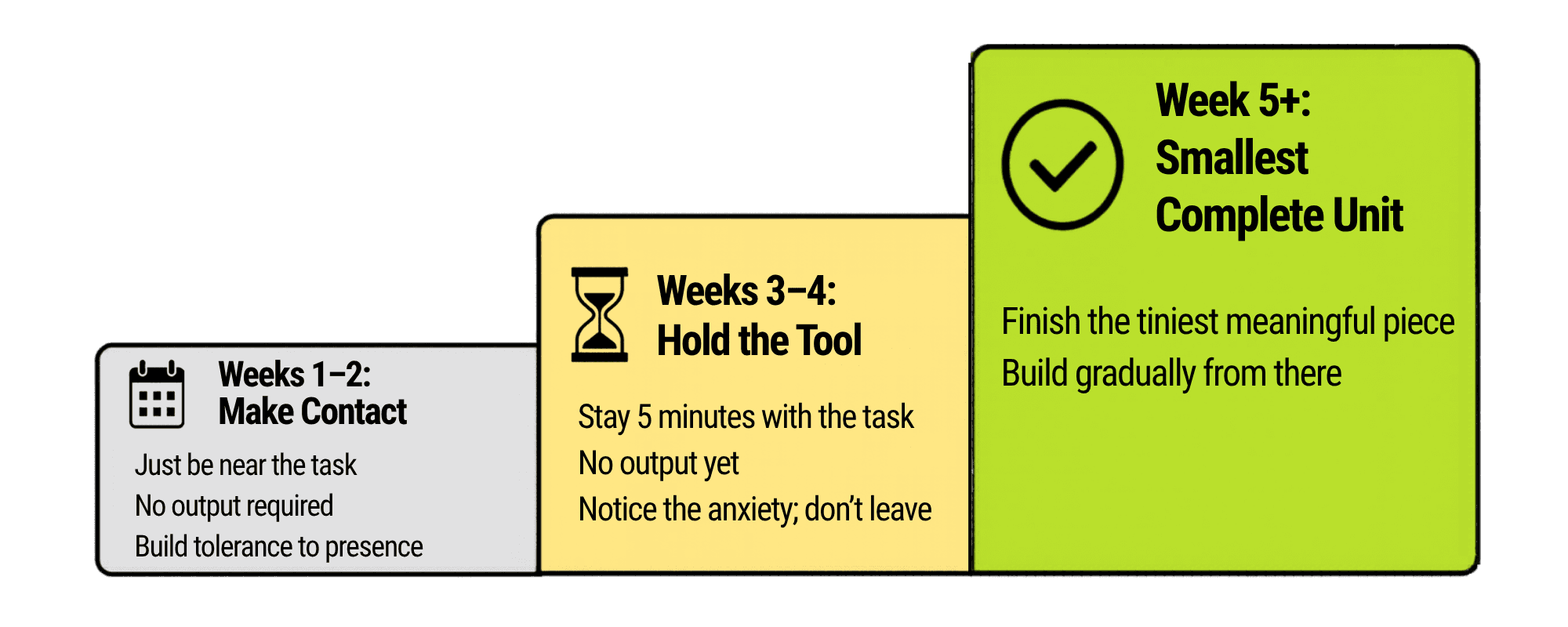
Weeks 1-2. During the first two weeks, your only goal is to be close to the task. If your goal is to paint a picture, spend a couple of hours a day near the canvas. Your goal is to get comfortable being “near the task” without working on it yet.
Weeks 3-4. Stay with the task for five minutes, no output required. Hold the paintbrush or mix some paints. The anxiety might still be there, and it’s normal to feel that way. At this stage, you are just building your tolerance.
Week 5. From week five onwards, your goal is to take small steps, such as drawing a sketch. Complete the smallest whole unit that you are comfortable with. Maybe you can only sketch one part of the painting at this stage. It’s okay. From here onwards, you are building the muscle whilst completing very small tasks. Eventually (and the timeline is different for everybody), you will be able to proceed to bigger tasks so long as you keep up the work.
It’s important to remember that progress won't be linear and that bad weeks will happen. But they don't erase what you've built. The nervous system is trainable. It just requires repetition, some patience, and an understanding that setbacks are part of the process.
Plus, if you’ve made it this far, you’ve already taken the first step towards unfreezing yourself.
If you're trying to work out which of these patterns applies to you, the Luumer quiz is a faster way in than reading everything and deciding for yourself.