Why you can't start - and what to do about it
Olya Zaplatynska
Last updated:
You know the feeling. The task is so boring that you just cannot bring yourself to do it. Or the task is so big and overwhelming that you just freeze and cannot start. Whether it's making the dream of your life a reality or cleaning the bathroom, pretty much everyone has experienced resistance to getting started. I know I have.
I've had an idea for a robotic pet toy for 8 years now. When it first came to me, I reached out to a friend I thought would be able to help me create it. After hearing some criticism and valid concerns, I put the idea to the back of my mind.
It kept resurfacing every now and then because I felt a genuine need for the product. Fast forward to now, I have three robotic kits and a huge box full of electronic components in the back of my closet, numerous courses purchased, and I am as far away from shipping the first toy to a happy customer as I was 8 years ago.
This experience has made me finally admit to myself something that I kind of already knew: I am bad at getting started with self-directed goals and big projects. I knew I wasn't lazy or disorganized. After all, I performed very well at work and school, where tasks were structured and clear. But I freeze and move meaninglessly when the entire path isn't clear.
This realization made me want to dive deeper into why people struggle with getting started, whether it's procrastinating on chores or undertaking big projects, and, most importantly, learn how to mitigate this issue, so that I can finally create that robotic pet toy!
Not all “I can’t get started”-s are made equal
People often confuse an inability to get started with procrastination. However, I think it's important to make a distinction here. The reasons behind the inability to initiate small everyday tasks (e.g., making a call, doing a chore, going to the gym) and big, life-changing projects (e.g., changing careers, moving countries, starting a business) are often different.
They are related, but not the same thing. Procrastination is usually about delaying something you already know how to do, e.g., you have the recipe, the ingredients, and the equipment, but you just won't start baking. Inability to get started is often a deeper issue: you lack the ingredients, you don't know what equipment you'll need, and quite frankly, you don't even know what you'll bake in the first place; you just know you want a dessert.
Sure, both small tasks and big goals can be blocked by, let's say, overwhelm or lack of energy, but under the hood, the mechanics behind the two can be very different. So it's worth keeping this in mind as we go through the mechanics of struggling to get started, as it will help you better understand your specific blockers and, subsequently, the tools that can help you get started.
Five core mechanisms blocking you from getting started
Most people assume that those who can't get started are just lazy or simply don't want to put in the effort, and if they were to "stop procrastinating and just do it," they would simply breeze through it.
In reality, someone who can't get started because they are terrified of failure needs a completely different set of tools than someone who has task initiation paralysis.
Thankfully, enough research has been done to distinguish five key areas that block you from getting started. These areas are:
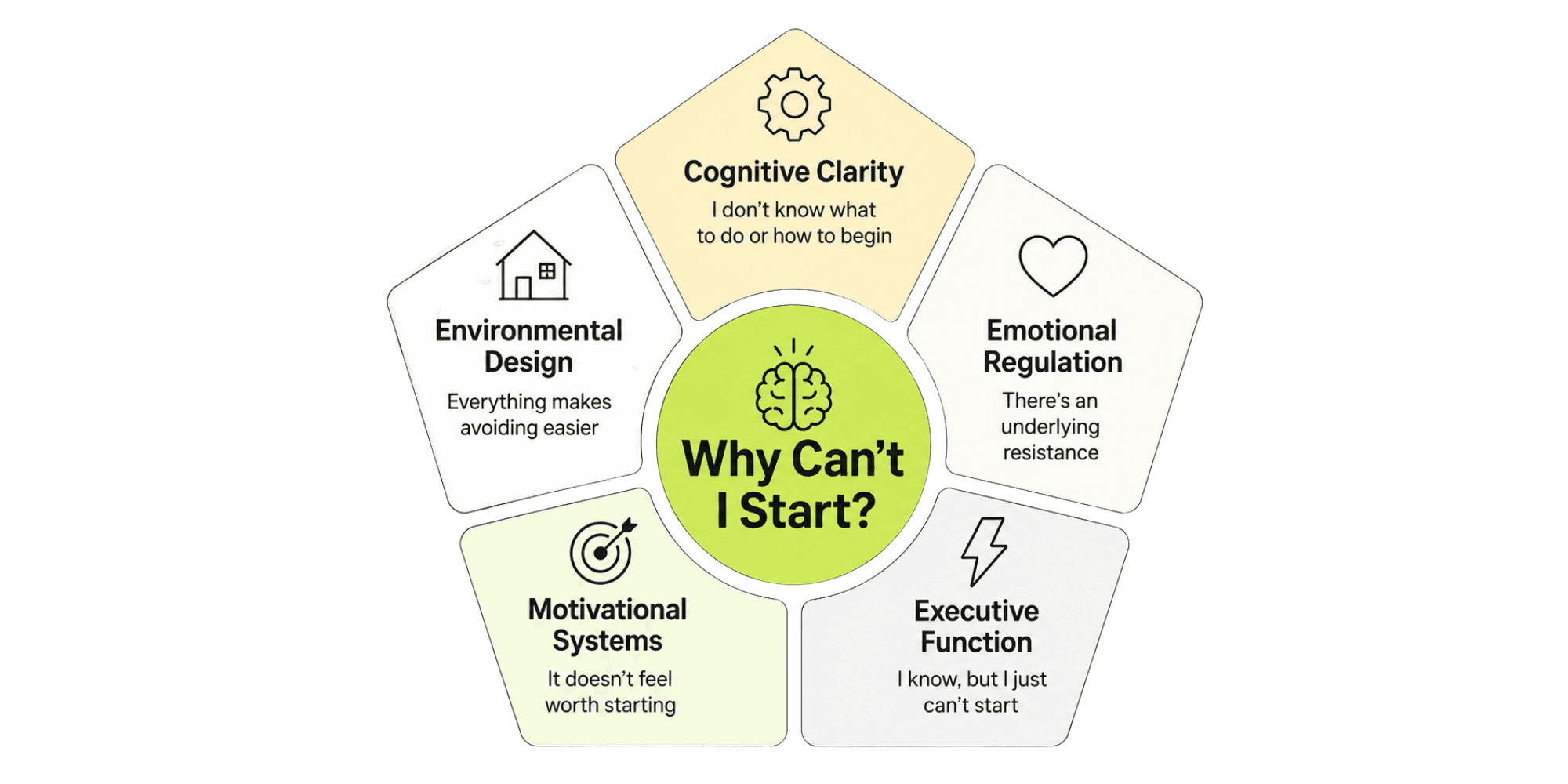
Cognitive Clarity – you don't know what to do, or how to go about it. Facing a new goal is like standing in front of a huge mountain on a foggy night, with visibility of less than 100ft.
Emotional Regulation – your brain's #1 job is to keep you safe, and that new undertaking has so many hidden dangers that it's definitely safer not to succeed, or even try.
Motivational Systems – the task doesn't feel worth starting right now, especially when there are so many quick rewards just a-few-taps-on-the-screen away.
Executive Function – you literally cannot initiate action, even when you want to, even when you are internally screaming at yourself to start. There's a cognitive gap in your brain that prevents you from starting.
Environmental Design – your surroundings make avoiding easier than starting (thanks, tech!)
Chances are, you've already recognized yourself in more than one of these short examples. They are often intertwined and stem from one another. So let's unpack each one in detail.
Mechanism 1: Cognitive clarity (you feel “I don’t know what to do and how to get started”)
The task is too vague
Your brain functions best when it knows what the next actionable step is. That’s why humans love routines so much - they help us function efficiently. Imagine not knowing what to do every morning after you wake up! Nightmare.
When a goal is vague (e.g., "work on the project," "become a better parent," "see the world"), your brain genuinely cannot route to it. It's not refusing. It just doesn’t know where it’s going and how to get there.
Neuroscience research confirms that unclear goals create something called cognitive avoidance: the brain encounters the ambiguity, finds no clear action path, and steps back from the whole thing.
What this means for you: The solution is to be specific with your goals and tasks. Lay out the next steps clearly, so that your brain always knows what the next step is. The moment you can name the next physical action - not "work on the report" but "open page7 and add a chart" - the brain can begin.
You have no system in place
Even when you know what to do, if the how, when, and where are still unclear, your brain can still stall. Lack of system requires building the entire launch sequence from scratch every time, and that is very energy-consuming for your brain. And if you're also dealing with low energy or competing priorities, your brain is likely going to shield itself from this new task.
Research by Peter Gollwitzer across 94 independent studies involving more than 8,000 participants found that what he calls "implementation intentions" dramatically improve task initiation. Simple if-then plans (e.g., if it is 8 am and I've had breakfast, then I will write 1000 words) effectively hand over control of your behaviour to environmental cues. You don't have to decide in the moment. The decision has already been made. This is a mini system.
What this means for you: To help your brain get started, ensure that you simplify the environment for it. Create a clear prompt for your brain, laying out what you will do, when, where, under what conditions, for how long, etc.
If this mechanism resonates with you, I have written an article dedicated to nine cognitive reasons that prevent you from getting started.
Mechanism 2: Emotional regulation ( you feel: "I don't understand why, but there's an underlying resistance to getting started")
Fear-based avoidance
Behind completing any goal is the danger of facing a plethora of uncomfortable truths. What if you aren’t good enough? What if others laugh at you? What if you fail and ultimately find out that you aren’t capable of achieving something you’ve been dreaming about? It might be safer not to know.
Research on self-worth theory describes procrastination as a "self-handicapping strategy": if you never really try, you can never truly fail. Your brain is just trying to protect you. If you listen to it too many times, this will harm how you see yourself. Missed starts and abandoned plans can quietly erode your self-confidence.
What this means for you: Understand that fear is a protective mechanism and if what you want to achieve is really big or requires challenging your identity, your brain might well be right. The solution isn’t bravery; it’s breaking down the task into batches and smaller to-dos to lower the barriers. Some people find that being private about their undertaking helps reduce the fear.
Perfectionism
High-functioning perfectionism is generally regarded as a good trait because it makes people strive for high quality but it doesn’t stop them from taking action. Whereas maladaptive (otherwise known as paralysing) perfectionism stops action because you if you cannot make it perfect, you shouldn’t even start.
Perfectionism is fear wearing a mask of high standards.
What this means for you: Ask yourself what type of perfectionist you are. Do you aim for perfection but settle for good enough and move forward? Or do you tend to give up when things aren’t perfect? The solution is to decouple your self-worth from the outcome. It’s useful to think: the first version is not the final version; it is just the version that makes the next version possible.
Identity conflict
Cognitive dissonance theory, one of the most replicated findings in social psychology, argues that people resolve the tension between their self-image and their behaviour not by changing the behaviour, but by rationalising or avoiding.
If you were told by your loved ones that no one in your family has ever been successful in business, and so neither will you, this belief will likely prevent you from starting your own business, even if subconsciously. Starting this task would require acting against your own self-concept. And that creates real psychological discomfort.
What this means for you: This is possibly the most empowering reason of them all because it’s often the hardest to diagnose yourself with. But once you’ve done it, you can begin to reframe your identity. “I'm not a disciplined person" will quietly defeat any productivity system you put on top of it. Small identity shifts - "I'm someone who shows up, even imperfectly" - create the psychological ground where starting becomes possible. Each time you do start, however briefly, you're casting a vote for a different story about yourself.
Past failures
Human brains are really good at spotting patterns and predicting the future based on these patterns. This is very useful when the pattern detected is “it gets dark in the night,” but not at all helpful when your brain decides “you’ve failed at this before, so you will fail again.”
Sometimes the resistance you feel to getting started has nothing to do with the task at hand. It’s a reaction based on past failures that might only distantly relate to the present. But again, your brain is trying to protect you from the shame and pain you felt before.
What this means for you: Be mindful and ask yourself whether the resistance you are feeling relates to a past experience. Naming it - “this feels like the project that failed two years ago” - will help you create distance between the current goal and the past failure. That prediction is outdated. You are a new you. The goal is likely different and the environment around you has changed.
Mechanism 3: Executive function (you feel “I know what I need to do but I just can't get started”)
Task paralysis
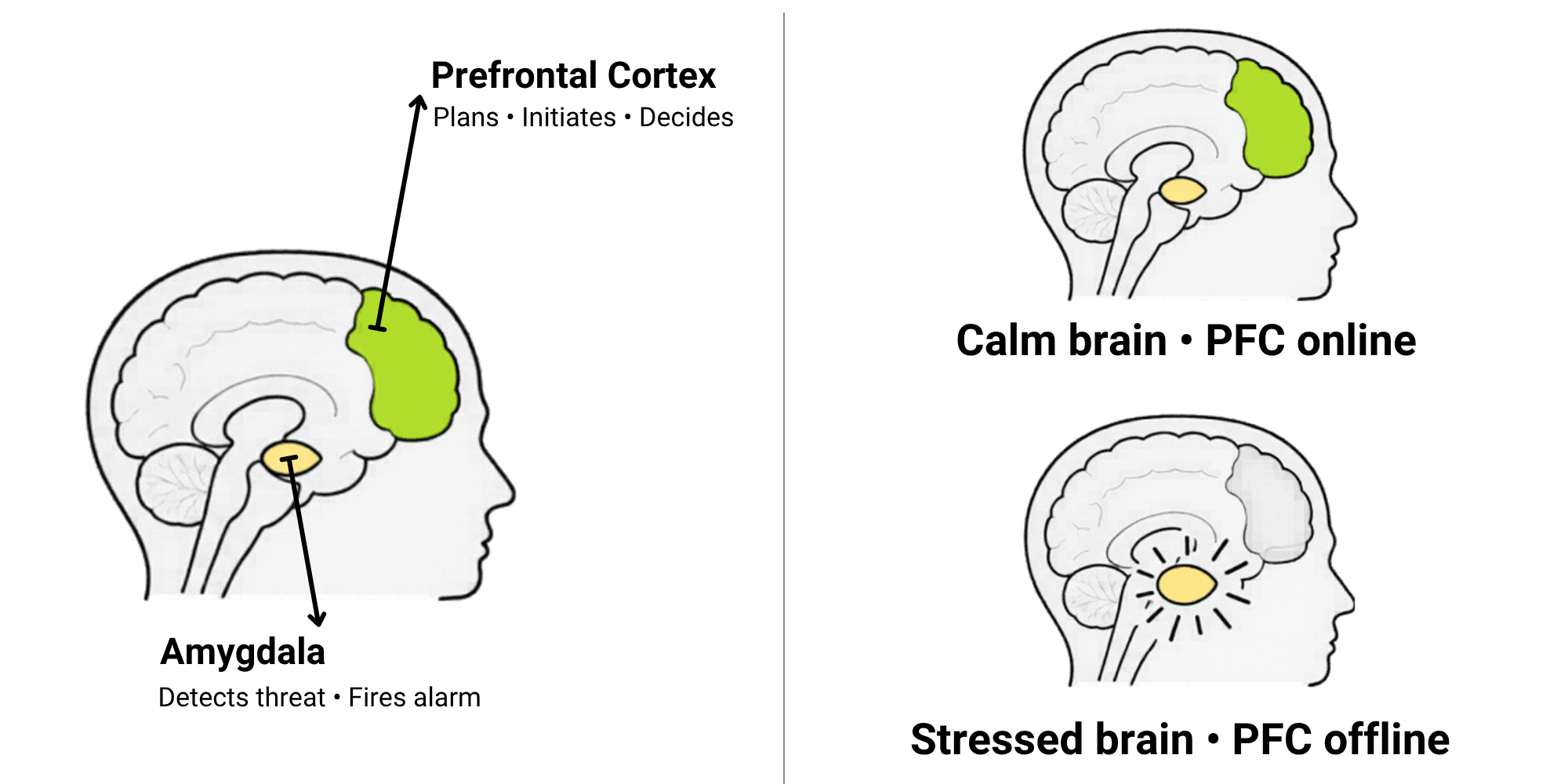
If you think of your brain as a car, executive function is the start button. It handles things like starting tasks, staying focused, switching between different activities, following through and finishing tasks.
This function mainly “lives” in your prefrontal cortex. When it’s underactive, overloaded, or dysregulated, self-control, planning, and initiating action can feel daunting, if not impossible.
Factors that commonly cause executive dysfunction are ADHD, depression, burnout, anxiety, low energy, significant stress, and mental overload.
Initiation paralysis often means that you want to do something, recognize its importance, know what you need to do, and yet you delay and just can’t get started; you feel frozen, stuck, unable to move forward with the task at hand.
It’s important to understand that this is not laziness. Mistaking initiation paralysis for laziness makes the “paralysis loop” worse.
You don’t start -> You feel bad about it -> You judge and blame yourself -> Starting feels even heavier next time because you already failed.
What this means for you: If you often know what to do but just can't get started, the first thing to combat initiation paralysis is to understand what's blocking you and find the right tool for you. There are many tools to try out, and we'll cover them in the next section. Your job is to try out as many as possible and see which one works best for you.
Overwhelm when facing a big task
This reason is probably the one I relate to the most. Having a goal that is so big that it not only is unclear but also challenges my identity, threatens my peace, and, to make it worse, my perfectionism blows an already big goal’s scope out of proportion. Result? Total paralysis.
Cognitive load theory has a clever explanation for this: When working memory is overwhelmed by task complexity, initiation stalls. The brain simply cannot hold the full task in view well enough to begin.
Telling someone overwhelmed to "just start" is like telling someone stuck in a traffic jam to "just drive faster."
What this means for you: The good news is that this goal is one of - if not "the" - easiest to tackle. Ask yourself, "What is the smallest thing I can do in the direction of this task/goal?" Keep breaking the task down until the task feels doable, and you are able to start.
Decision fatigue
Every decision you make takes a bit of energy and consumes your cognitive resources. If you do not prioritize your most important tasks in the morning, chances are that by the time you get to them, your decision-making power will be depleted. Couple this with a lack of structure and clarity, and you will struggle to get started with an unappealing or overwhelming task.
What this means for you: Planning your day the night before is a great way to be more productive, especially when it comes to tasks that you struggle to start. Being armed with what, when, and how helps your brain by reducing the choices and decisions it will have to make; all it has to do is the work at hand.
Lack of energy
When you get into the nitty-gritty of the psychological reasons behind the inability to get started, it’s easy to forget the basic, yet important reason: an energy deficit. A single night of poor sleep measurably reduces prefrontal cortex activity, impairs executive function, and weakens the top-down cognitive control needed to override avoidance impulses. Chronic sleep deprivation compounds this over time.
Burnout has a similar effect on your emotions. It reduces self-efficacy and causes emotional exhaustion, and both affect your ability to get started.
If your brain is under-supplied, getting started with something new, is quite literally impossible, as it has to prioritise and cover the basics first.
What this means for you: Rule out sleep deprivation and emotional burnout first. No amount of planning, identity work, or goal breakdown compensates for running on an empty tank, and pretending otherwise just adds guilt to exhaustion.
Absence of the starting habit
As mentioned above, our brains love the predictability of a routine and spend a lot of energy on making new decisions.
Philippa Lally's research at UCL found that automaticity takes between 18 and 254 days to develop, with a median of 66 days. Brain imaging research shows why: as habits form, activity shifts from the prefrontal cortex (effortful, deliberate) to the basal ganglia (automatic, low-energy). Once a behaviour is truly habitual, it persists even when motivation dips because it no longer depends on motivation.
Until then, every start is a first-time decision. And first-time decisions are the most cognitively expensive kind.
What this means for you: When starting a new recurring task, give yourself an average of 66 days to form a habit. And until the habit is formed, expect it to be hard to get started. Use the tools and mental tricks to help you initiate action (summarized in one of the next sections).
Mechanism 4: Motivational mechanisms (you feel “It doesn’t feel worth it to get started”)
The goal isn’t actually yours
Some goals are just expectations that society, your family or partner has placed on you. They are not truly your own, and the motivation to achieve them is low. These goals stem from external pressure and are mainly driven by guilt or approval-seeking. It's no wonder that you struggle getting started on achieving them when deep down you don't actually want them.
What this means for you: Before blaming yourself for not starting, ask whether the goal is actually yours. Whose voice do you hear when you think about it? If it belongs to a parent, a partner, or a version of yourself from ten years ago, no productivity strategy will compensate for lack of genuine motivation. If you are struggling to uncover the true origin of the task, try guided meditations or working with a therapist to unveil the subconscious reasons behind your goals and dreams.
Sometimes, the most courageous thing is to stop trying to force-start something that was never genuinely yours to begin with.
The reward is too far away and there’s no feedback to inform you of your progress
An interesting thing that I found out during my research into why I struggle getting started is how our brain values present actions based on immediate rewards.
fMRI studies by McClure and colleagues show that future rewards activate the prefrontal cortex - the rational, planning part of the brain - while immediate rewards activate the limbic system, the emotional, reactive part. When both are competing, the limbic system almost always wins.
Even though it might be much more important to you to finish writing your paper, your limbic system will prevail, and you’ll pick up your phone and begin scrolling. The reward for scrolling is an immediate dopamine hit. The reward for working on your paper is distant and uncertain, and the project itself is huge and overwhelming. No wonder our brains choose phones.
The good news is that our brains release dopamine not only when rewards arrive but also when the progress happens. Researches from Harvard Business School have analyzed 12,000 dairy entries from knowledge workers and found that the single most powerful motivator that keeps us continuing to work on a goal is visible daily progress. Not achieving the goal itself, but having feedback from the system you've created about your daily achievements.
What this means for you: Ensure that every time you get started and work on your task, you get an immediate reward. Break down your goals into small, bite-sized tasks, write them down and cross them out when you are done. Divide the goal into milestones and celebrate each one. And my personal favorite trick is to have a tasty snack after each daily session (and sometimes during).
Mechanism 5: Environmental design (you feel “Most things around me prevent me from getting started”)
Environmental friction
The same person can be highly productive or highly avoidant based on the environment. Removing hurdles and setting up your environment in advance will help you get started. Adding or removing just 20 seconds of effort from a behaviour meaningfully changes how often it's chosen.
Richard Thaler and Cass Sunstein whose work on choice architecture won a Nobel Prize, demonstrated that the design of the environment and how choices are presented profoundly influences which choices are made. Their most famous example is this: changing retirement plan enrolment from opt-in to opt-out raised participation from 49% to 93%. Same plan, same options, same people. Just a different default.
What this means for you: Set up your environment before you get started on your task. Don’t aim for the ideal conditions; strive for good enough. Create a list. Set up your desk. Do a quick clean of the room. The more hurdles you remove, the easier it will be for your brain to get started.
Tech devices are powerful distractors
Enough studies and experiments have been done to prove that we are addicted to our gadgets.
After all, we have the brains of our ancestors that weren’t able to evolve fast enough to keep up with the technical revolution we are witnessing today. And the revolution is showing no sign of slowing down. In fact, it’s accelerating. Our brains are learning to fly the plane while flying it.
The apps are designed to hook you using intermittent reinforcement - the same psychological principle that drives gambling. Variable, unpredictable rewards produce the strongest and most persistent behavioural responses known to psychology. Every time you hear the phone buzz, it’s an exciting mystery: is it a text from a friend, a promotion notification, or new content from your favorite influencer? Either way, you get a dopamine hit.
It is important to recognize that you are one person competing against an army of app developers that sponsor a lot of research to fine-tune the mechanics of hooking you on your devices. Understanding this removes the guilt and helps you move forward, making smarter choices.
What this means for you: You might have already known this or even tried it. Keep your phone in another room. Switch on “Do not disturb” on all devices when you do deep work. Or get one of the device locker boxes that open up when the timer you set expires. Or use your phone as a reward for completing a task: give yourself a well-deserved, guilt-free 15 mins scroll time.
A reason that can’t be ignored: mental health
It's worth naming something directly: for a significant number of people, the barrier to starting is not a productivity problem at all.
A systematic review of 43 studies found that individuals with depression demonstrate reduced willingness to expend both cognitive and physical effort for rewards - and this motivational deficit can persist even after the depressive episode has lifted.
When you are struggling with depression, burnout or anxiety, many productivity tools and tricks might be ineffective.
What this means for you: If you have tried environmental design, creating habits, reducing overwhelm, etc., and nothing has worked, it might be time to reach out to a professional. A depressed or burnt-out nervous system needs a different kind of support than a disorganised one. There is no productivity hack that substitutes for treatment, rest, or clinical care. Getting help with what's underneath your inability to get started is, in many cases, the most productive thing you can do.
Which mechanism is failing you?
Now that we have covered the main reasons why people struggle getting started, you should have a better understanding of what is causing your occasional procrastination, and what is paralysing you when facing your life's dreams.
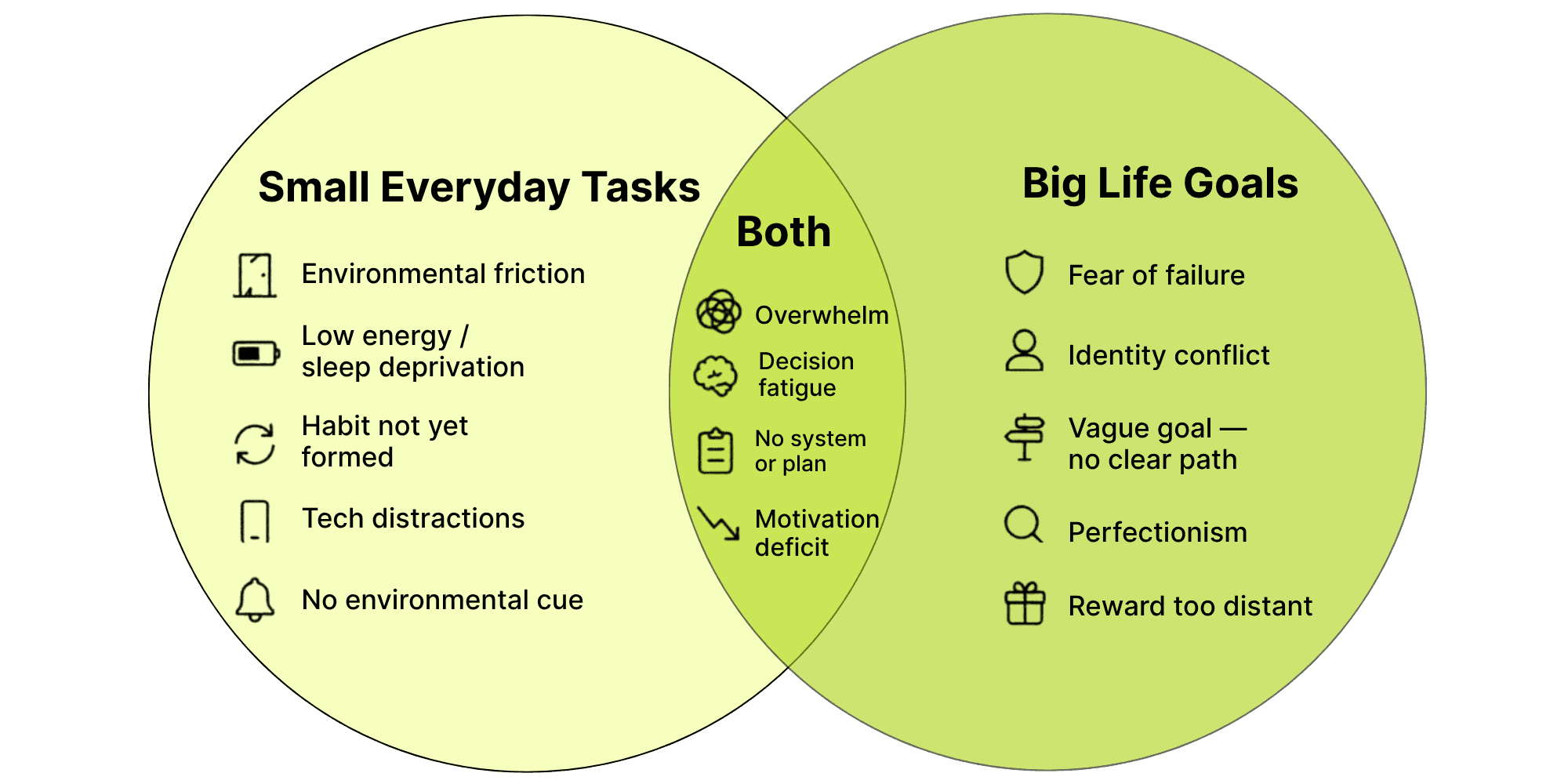
To wrap up: distinguishing between small tasks and big goals. Small things are often blocked by friction and low energy. Big goals are blocked by fear and identity.
I have created a quick Venn diagram to put this into perspective using the 5 mechanisms we discussed above.
Still at a loss? Take a quiz.
Most people struggle to understand what the main factors are that hold them back from getting started. You can probably relate to most of them one way or another, but there are usually a few main ones that you should negate first for the biggest effect.
I have prepared a short quiz to help you understand what the main 3 factors are that prevent you from getting started.
Once you have completed the quiz, come back to this article to find out more about the tools that will help you tackle your specific mechanisms.
What actually works to help you get started (evidence-based tools)
Procrastination has become such a ubiquitous part of human life that research on the causes and how to combat it is plentiful. Here’s what evidence points towards.
Create lists and break down tasks. Having clarity on the next small step is the single most powerful way to easily get started. It helps you dismantle a big task, name the next action, and reduce the energy your brain needs to get started. And all of this can be done by an app for you.
Helps combat: task ambiguity, decision fatigue, overwhelm, lack of system, and lack of feedback and reward.
Implement the “If-then” planning. The magic of the “if-then” is that it removes the in-the-moment decision entirely. It automates the process of getting started and has been shown to dramatically improve task follow-through, with a medium-to-large effect size across 94 studies. Create conditions like “If I finish 30 minutes of deep work, then I can use social media for 10 mins guilt-free.”
Helps combat: lack of system, absence of starting habit, environmental friction, and reward delay.
Make the first step as small as possible. This hack goes hand in hand with creating lists and breaking down tasks. Yet it takes the approach a few steps further, lowering the entry barrier until it feels doable. Keep shrinking the first task until you feel "unstuck."
Helps combat: initiation paralysis, overwhelm, lack of energy.
Set up the environment for your success. Whatever it is that you are doing, follow this simple rule: reduce friction before the behaviour, add friction before the distraction. In other words, make starting as simple as possible and make distractions as difficult to access as possible. For example, clean up your desk, write a task list, and lay out your tools in the evening; in the morning, put on "do not disturb" mode on your devices and a physical sign on your door.
Helps combat: environmental friction, distractions, and decision fatigue.
Be kind to yourself. It is hard to overestimate the importance of kindness and forgiving yourself for not getting started. Being gentle to yourself improves the way you self-regulate your emotions which in return helps you to get started next time. Moreover, by being angry or frustrated with yourself, you create a loop and get stuck in procrastination. Harsh self-criticism amplifies the negative emotions that caused avoidance in the first place. Self-compassion is not a sign of weakness -- it is about not weaponising past failures against future starting.
Helps combat: fear-based avoidance, perfectionism, identity conflict, and fear based on past failures.
Connect the task to the (new) identity. If you’ve read James Clear's Atomic Habits, you’re probably already familiar with this concept: identity-based motivation is more durable than goal-based motivation. "I am a person who writes every morning" creates a different relationship with sitting down to write than "I want to write more." Each act of starting becomes a small vote for the identity you're building.
Helps combat: identity conflict and past failures.
Track progress visibly. Harvard Business School's Progress Principle research found that visible progress on meaningful work is the single most powerful daily motivator. That's why breaking down your goals into small tasks that can be finished in a day feels very rewarding.
Helps combat: task ambiguity, task initiation paralysis, lack of energy, reward distance and lack of feedback.
Use an app. I have developed Luumer to help myself and people like me get started with achieving goals. Luumer is a goal breakdown and tracking app designed around the science of how people actually start and sustain meaningful work. It helps you deconstruct big goals into small, actionable tasks, always giving you clarity on what comes next. And it has a reward system built in to keep your brain happy.
Helps combat: task vagueness, task initiation paralysis, overwhelm in the face of a big goal, decision fatigue, lack of feedback, and lack of reward.
Reward yourself for getting started. Giving yourself little gifts for completing the tasks is a powerful motivator. It not only makes it worth it for the brain to work on the task, but also it's self-care: giving yourself well-deserved gifts is a sign of self-love that will help you get started and keep going for all the right reasons.
Helps combat: reward distance, lack of feedback, and lack of energy.
Meditation. Having a deep meditation session is like resetting your computer. Many issues go away after you have cleared your brain. Your nervous system goes into recovery mode, your stress reduces, and you gain mental clarity. What has really helped me is using meditation as part of the "if-then" system. Meditation can clear your canvas and help you be better prepared for starting work on important tasks.
Helps combat: task initiation paralysis, overwhelm, lack of system, and environmental friction.
Tool | Cognitive Clarity | Emotional Regulation | Executive Function | Motivation | Environmental design |
|---|---|---|---|---|---|
Create lists & break tasks | ✅ | ✅ | ✅ | ||
If-then planning | ✅ | ✅ | ✅ | ||
Smallest first step | ✅ | ✅ | ✅ | ||
Set up the environment | ✅ | ✅ | |||
Self-compassion | ✅ | ✅ | |||
Identity connection | ✅ | ✅ | |||
Track progress visibly | ✅ | ✅ | ✅ | ||
Reward yourself | ✅ | ✅ | |||
Meditation | ✅ | ✅ | ✅ |
The bottom line
If you are like me, and you spent your life convinced that there is something fundamentally wrong with you (when in doubt, blame brain wiring!), I hope you now know that this problem has a solution.
You can design a task system that is tailored to your needs. You can restructure your environment to support your best work. The tasks can be made smaller. You can reward yourself for small achievements. You absolutely can shift your identity.
I can’t promise this will happen quickly. Research on habit formation suggests that new patterns take weeks to months to become automatic. In fact, I am still in the process of changing my identity. But it’s so worth it.
Here’s a quick how-to recap:
Understand what's in the way of you getting started on big goals, small tasks, and both.
Try out the tools that help combat your specific procrastination reasons.
If nothing helps, seek professional help to rule out underlying mental health issues.
Stick with tools that work best for long enough for a habit to form.
Work on shifting your identity.
And remember: achieving any goal, completing any task, starts with taking that first tiny step. What will it be for you?