How to fix executive dysfunction when your brain won't cooperate
Olya Zaplatynska
Last updated:
What it is, why it's worse than ever, and what actually helps.
The technologically advanced world has given us a lot. Free access to information from practically anywhere in the world, same-day delivery, the ability to talk to a friend on another continent for free, and a thousand other things our parents would have called magic.
It has also handed us things we didn't sign up for, including a steady decline in our collective ability to start, sustain, and finish what actually matters to us.
Over the last few years, many people have self-diagnosed themselves with ADHD. Those who went deeper often uncovered issues with their executive function, also known as executive dysfunction.
Executive dysfunction is a cousin of ADHD, but what most people don't know is that even though executive dysfunction is a defining feature of it, ADHD doesn't own it.
People with anxiety and depression experience executive dysfunction, as do those with long COVID, peri-menopause, sleep debt, post-concussion symptoms, autism, trauma history, and frankly, a lot of stressed adults who don't fit any clinical category at all.
Whether a clinician has diagnosed you or you've spent three weeks watching TikToks, reading comments, and feeling weirdly seen, this article is for you.
I'll explain what executive function really means, how it looks when it's working well, and how to spot when it's not. I'll also talk about why so many people are now diagnosing themselves with ADHD.
Most importantly, I'll share what you can do about it: quick tips for when you feel stuck, ways to use technology to support your executive function, and longer-term changes that, with some consistency, can help address the root causes of executive dysfunction.
I'll keep things practical and focus on steps you can take right now.
What is executive function?
Simply put, executive function is the bundle of mental skills that get you from "I should" to "I am."
It's the part of your brain that picks what to do next, keeps track of the steps long enough to finish them, helps you ignore distractions, lets you switch plans when needed, and notices when something isn't right so you can make changes.
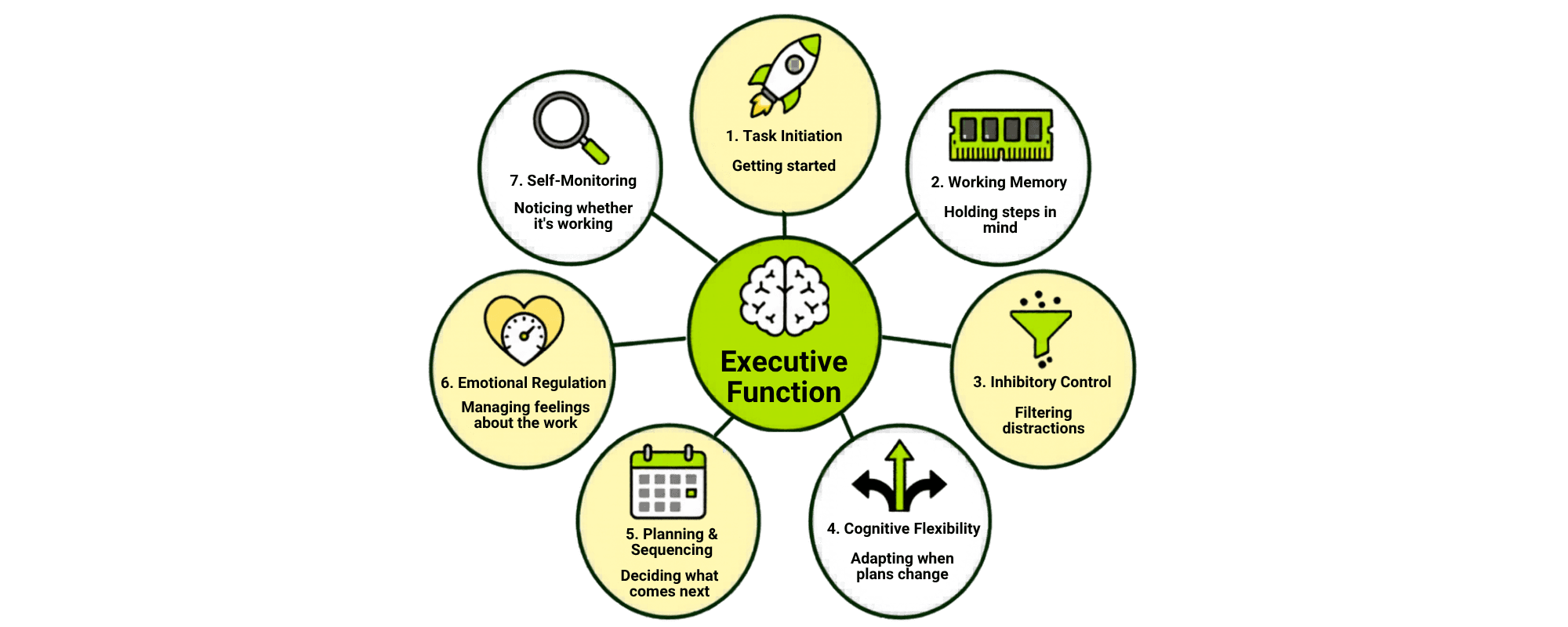
It runs on roughly seven sub-skills:
Task initiation. Helps you get started.
Working memory. Holding the steps in your head while you do them.
Inhibitory control. Not getting distracted by the outside world when you work.
Cognitive flexibility. Shifting when the situation changes.
Planning. Sequencing what comes after what.
Emotional regulation. Managing the feeling that comes with the work.
Self-monitoring. Noticing whether what you're doing is working.
Like everyone else, you might be great at some of these skills but struggle with others. For example, someone who can remember ten ingredients while cooking might still have trouble filing a single piece of paperwork. It's the same brain, just different strengths.
Executive function works as a system that performs unevenly, day to day, depending on sleep, stress, hormones, what you ate, and how much dopamine your brain has access to right now.
Calling it "dysfunction" can make it sound like something is permanently broken. But for most people, executive function just works better some days than others, and the reasons aren't always clear.
When executive function is working well, the gap between deciding to do something and doing it is small.
When executive function fails, that gap can stretch for hours, days, weeks, months, years, and even decades.
If this sounds familiar but you think there are other reasons you can't get started - like emotional ones - you might want to read 'Why you can't start - and what to do about it.' That article covers five different systems that can make starting hard. Here, I'll focus just on executive dysfunction.
How executive dysfunction shows up in real life
Scientists and everyday people often describe executive dysfunction in very different ways.
The textbook says that executive dysfunction is difficulty initiating, sustaining, and completing tasks.
Whereas the lived experience says: I have reread this email seven times and still have not replied. The dish has been in the sink for four days.
You might be very capable in some areas but totally unreliable in others, and that gap can be the most confusing part of living with executive dysfunction.
To help you recognize executive dysfunction, I have prepared a few more examples of how it shows up in different spheres of life.
At work: You can do your job well once you're in motion, but starting takes 90 minutes. You answer the easy emails first because the hard ones feel like climbing a wall. Meetings get prepped at the last possible moment because urgency is the only thing that gets you started.
At home: The dishwasher needs unloading. You know it, and you've been thinking about it for an hour. The thought of doing it becomes bigger than the task itself, but the dishes still don't get done.
In your own head: You watch yourself not do the thing. There's a particular, dull exhaustion that comes from not having done something that you need and want to do.
People who haven't experienced executive dysfunction might ask if you're just tired from working. But in reality, you're tired from all the things you didn't do.
The "I don't have time" version
There's a specific flavor of executive dysfunction I want to name carefully, because I lived it for years.
For a long time, I told myself I couldn't work on my self-started projects because I didn't have the time. Then I started researching this subject and realized I had been keeping myself busy on purpose. Not consciously, but functionally.
Every time I had time to work on the task, I'd find something (a small admin task, a bit of laundry, a chat with a friend, a quick reorganization of the kitchen drawer) that filled the space just enough to stop me from working on it.
It felt overwhelming to pretend I didn't have time. Not knowing how or where to start, combined with fear of failure, led to a clever kind of avoidance. There always seemed to be something else that needed to be done first.
I want to be clear on something, though: some people genuinely don't have time. A full-time job, three kids, a sick parent, and no help is, unfortunately, the reality of many people. If that's you, please don't add a layer of self-judgment on top of an already heavy load. You are doing the best you can with the cards dealt.
But if you do have time and it always gets filled with "useful" busywork whenever an important task comes up, it's worth taking an honest look at that pattern.
The test I use on myself: am I always doing something productive? Yes. Am I doing the thing I most want to be doing? No. That mismatch, repeated for years, is data.
If every time you sit down to work on an important task, you freeze and cannot bring yourself to start, it's worth reading "Task paralysis: what it is, why it happens, and how to deal with it," which covers that "freeze" response in depth.
Why executive dysfunction feels worse than it used to (it's not just you)
You're not making this up. Technology really is changing our brains, and research backs it up.
I keep coming back to this notion: our brains evolved for a world that's nothing like the one we live in now.
Our nervous systems were tuned over hundreds of thousands of years to live in small groups, walk a lot, sleep with the dark, eat when food was available, and respond to threats in short bursts.
The world our brains were made for changed slowly, like the seasons. Now, everything moves as fast as the next notification.
Evolution can't keep up in just one generation. So now there's a gap between how our brains work and what we expect them to handle.
This gap is most obvious in executive function, since it's the part of the brain most affected by things like noise, sleep, stress, and rewards. All of these have changed a lot in our modern world.
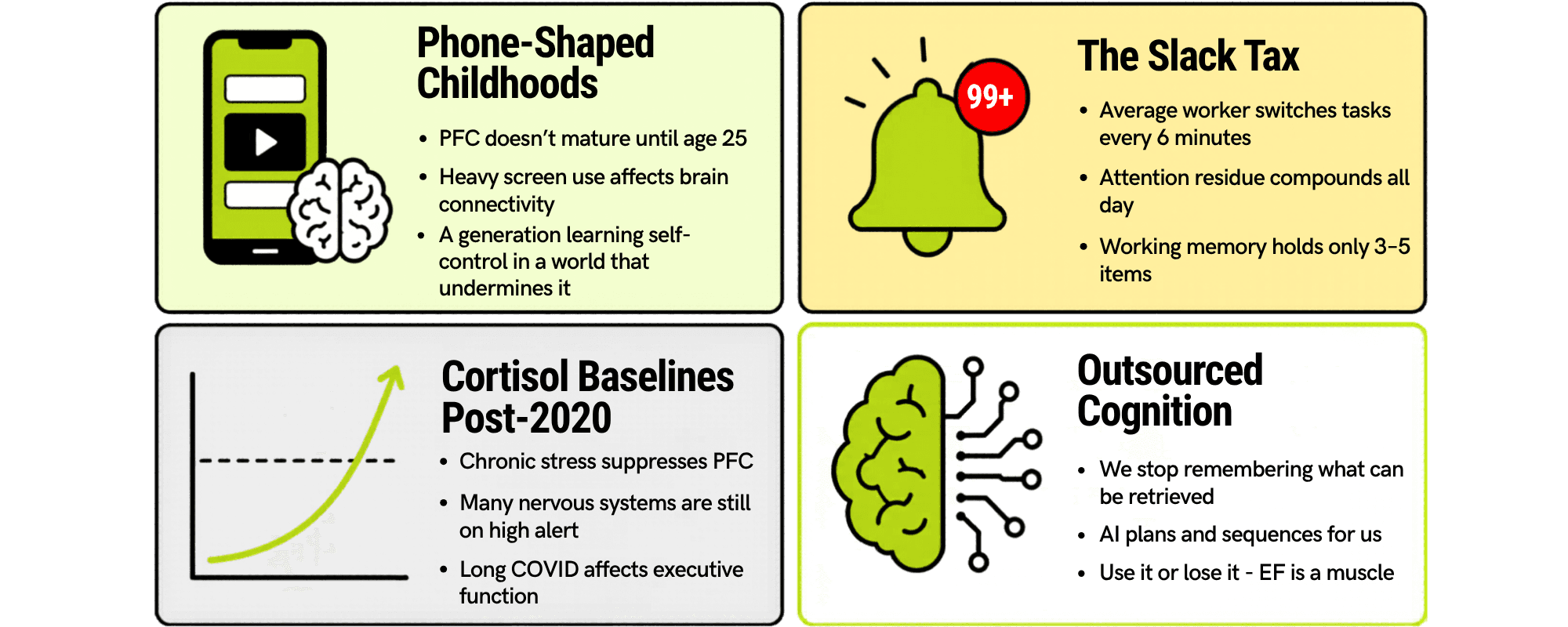
Four pressures, specifically, have rewired our brains and made us suffer from executive dysfunction.
Phone-shaped childhoods
The prefrontal cortex, which handles executive function, doesn't fully mature until about age 25. People born after 2007 - now in their late teens or early twenties - grew up with highly attention-grabbing technology in their pockets during this key time.
Studies have found that higher levels of screen media use in children were associated with differences in cortical structure and brain connectivity in areas linked to language, attention, and executive control.
The direction is consistent across many studies. Heavy screen exposure during a developmental age appears to leave a mark on exactly the brain region this article is about.
To put it simply, an entire generation is trying to learn self-control in a world that's set up to make it harder.
The Slack tax
For the rest of us, the work environment changed.
Sophie Leroy's 2009 research at the University of Washington described a phenomenon called attention residue: when you switch from one task to another, part of your attention lingers on the previous one.
The cost isn't obvious. You might feel like you've moved on, but your mind hasn't fully switched. So the next task only gets part of your attention.
Now consider that the average knowledge worker checks Slack or email every six minutes. Calendars are fragmented into 30-minute slots. Most jobs involve at least three different communication channels running at once.
Your working memory and inhibitory control are doing 200 small task-switches a day, every day, and paying the residue cost on every single one. However, studies have shown that working memory can hold only 3-5 items at a time.
Today's workplaces demand more from our executive function than it was ever meant to handle.
Cortisol baselines after 2020
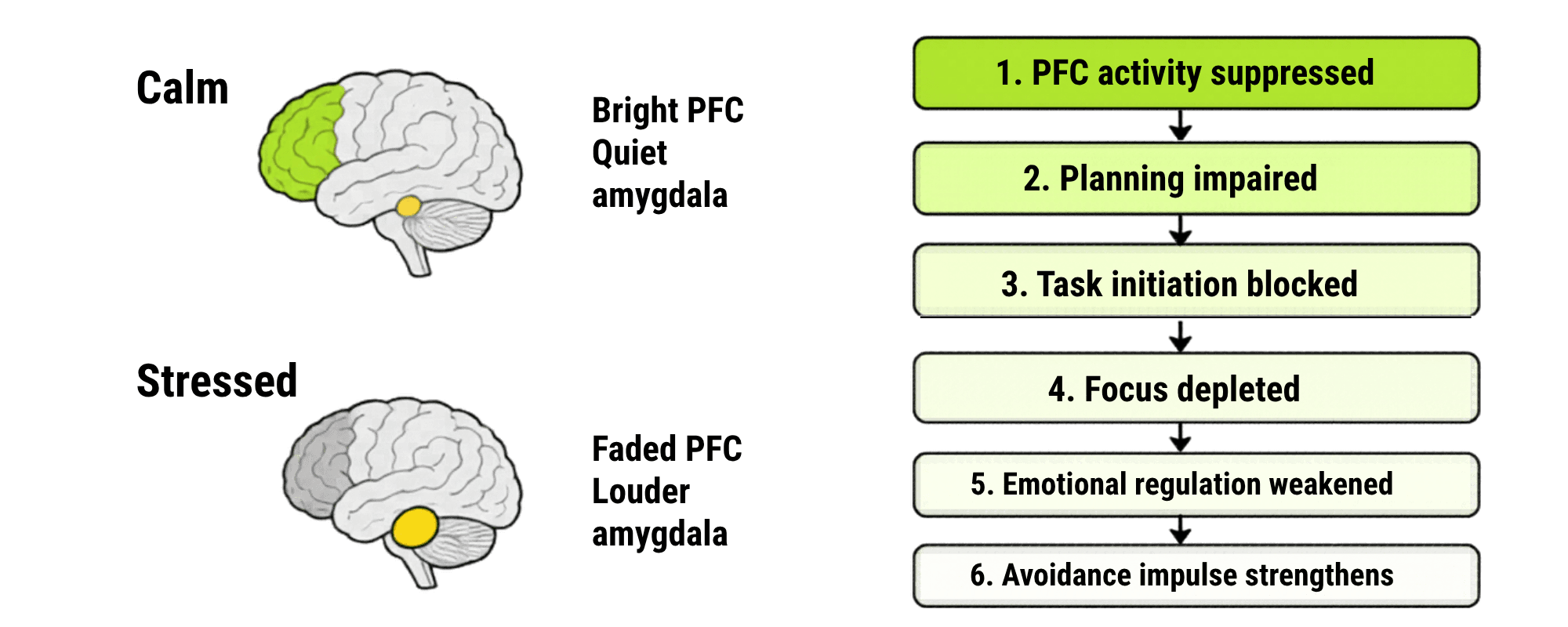
Chronic stress reduces prefrontal cortex (PFC) activity. Yale researcher Amy Arnsten has shown that even mild, sustained stress can take the PFC offline at the synaptic level. When that happens, the rest of executive function follows.
The period from 2020 onwards left many nervous systems on high alert. In addition to making millions of people perpetually anxious, long COVID has been documented to affect executive function.
For many people, "I used to be able to do this" is genuinely true. The body running the brain is now in a different state.
Outsourced cognition
Sparrow et al.'s 2011 research at Columbia introduced what's now called the Google effect: once we know information is reliably retrievable, we stop trying to remember it. We remember where to find things instead.
It's usually okay to offload information on purpose. The real problem starts when we let technology do the thinking for us, not just the remembering. AI has made this issue even bigger.
AI assistants will plan your week, AI agents will draft your email, and sequence your project. Tools that hold the steps for you can be a useful scaffold. The trap is letting them become a replacement for the underlying skills, like planning and breaking goals into steps.
"Use it or lose it" applies to executive function just like it does to muscles. If you never practice planning or keeping steps in mind, those skills get weaker.
So you're not imagining things. The challenges to executive function are real and mostly outside your control. That means it's important to focus on what actually helps in today's world.
How to fix executive dysfunction
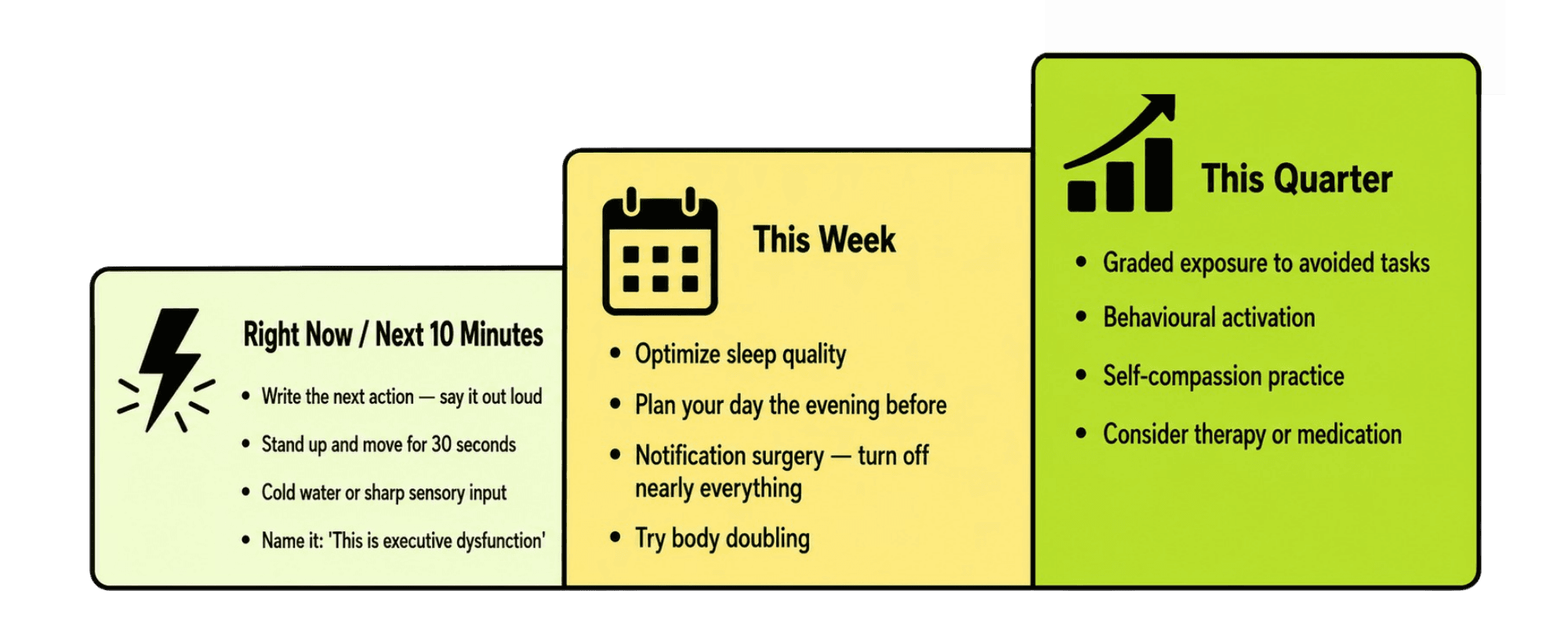
I've put together three levels of tips you can try if you struggle with executive dysfunction. The idea is to set up conditions that help your brain work better, so your executive function can slowly get stronger, just like gently rehabbing a sprained ankle.
I'll go through 3 time periods: Right now, this week, this quarter.
Right now (in the next ten minutes)
For when you're stuck and just need to move.
Write down the next physical action, then read it out loud. Putting the first step on paper helps your brain get started. It's important to write by hand, not type. Then, say it out loud. Speaking uses a different part of your brain, and for a frozen mind, this small step can make the action feel real rather than just an idea.
Stand up and move around for thirty seconds, or do a few jumping jacks. Research by Diamond and Ling (2016) found that even short bursts of movement increase blood flow to the prefrontal cortex and boost executive function. Don't just sit and wait to feel ready. A little movement is enough.
Try a sharp sensory input like splashing , cold water on your face, sucking on a strong mint, or putting ice on your wrist. These quick jolts help your nervous system snap out of a heavy, foggy, frozen state. Movement and cold are both ways to recover from it.
Name what's happening. Say it out loud: "This is executive dysfunction. It will pass. I will start working." Naming a state activates the prefrontal cortex and quiets the amygdala (according to Matthew Lieberman's labeling research at UCLA). Sounds simple, but it works.
These tips won't fix deeper issues, but they can give you the first thirty seconds of momentum, which is often all you need to get started.
This week (build the conditions)
This is where most people get stuck, because the right-now hacks stop working when the underlying conditions are bad.
Sleep. I get it - telling a parent of five to "just get more sleep" isn't helpful. So let's look at it differently.
If you can get more sleep, get more sleep. If you genuinely can't, work on the quality of what you do get: a colder room (around 18°C suits most people), no devices in the bedroom, no scrolling for the last 30 minutes before bed, and a brief meditation or breathing exercise to come down from sympathetic activation. These make the hours you do have more restorative.
If quality sleep has been impossible for a long time and you can feel yourself unraveling, please ask for help. Chronic sleep deprivation can cause permanent cognitive and emotional damage. Asking for help from a partner, family member, friend, GP, or therapist is part of taking the problem seriously. No productivity hack compensates for an unrelenting sleep deficit, and pretending otherwise just adds guilt to exhaustion.
Reduce decision fatigue. This is a popular trick in productivity circles. Write your to-do lists the evening before. This way, when you arrive at your desk (or elsewhere) the next morning, you’ll already know what to do; what your first step should be. "At 9 am, I will open the budget spreadsheet and update row 14."
Try switching from a regular to-do list to a capture system. For some, to-do lists are helpful; for others, they're overwhelming. Long lists can overload your working memory. A capture system - anything that keeps steps in order and shows you the next action - takes that pressure off. The format doesn't matter as much as the function. Use a notebook, an app, or sticky notes—whatever works for you.
Perform a notification surgery. Go through every app and alert, and decide which ones really deserve your attention. Most don't. Turn off everything except messages from people you care about. Your ability to ignore distractions is limited, so don't waste it on news or updates you can't affect.
Caffeine timing. Be mindful of when you drink caffeine. It stays in your system for about five hours. That 4 pm coffee might help you finish a report, but it can also ruin your sleep and hurt your executive function the next day. Most doctors suggest having your last coffee by noon. You don't have to quit, just time it so it helps, not hurts.
Body doubling. If you find you work better when someone else is around or when you've shared your plans, this technique might help. Working alongside someone, either in person or online, can make it much easier to get started on tasks.
This quarter (rebuild capacity)
For when you want to move out of crisis mode and into something more durable.
Graded exposure for the things you freeze on. Pick one task category that consistently triggers shutdown.
Week one to two: just make contact and tolerate the task. Open the file, look at the document, and sit at the desk. For five minutes, just be in the presence of the task. Then stop.
From week three on, focus on finishing the smallest possible tasks. Your brain changes through repeated, low-pressure attempts at things that used to make you freeze. This is like building muscle - steady progress makes a real difference over time.
Behavioral activation. Action comes first; motivation follows. Schedule small, specific actions on specific days, and do them whether you feel like it or not. Lower the threshold so that the task is as small as it needs to be to get started, but also lasts long enough to build some tolerance. Gradually increase the length over time.
Self-compassion is actually used as a clinical tool. Being hard on yourself makes you avoid tasks, but being kind to yourself helps you come back to them. Research shows that treating yourself with compassion after a setback leads to better follow-through. If you usually feel shame when you can't start something, working on self-compassion can make a big difference.
Therapy and medication can help when needed. For people with ADHD, doctor-prescribed and supervised medication can make a big difference. If you think this applies to you, consider talking to a clinician.
Tech as a scaffold for executive function
This deserves its own section because of the specific irony of where we've ended up.
The same kinds of tools that have weakened executive function for many people can also be some of the best supports for it.
The key difference is in how the tool is designed. Is it made to grab your attention, or to help you focus and get it back.
Here’s a useful test for any tool: does this add to my working memory load, or subtract from it? Anything with notifications, infinite scroll, or content you didn't request is adding load. Anything that holds the steps for you, in order, with the next action visible, is subtracting it.
Once you know which sub-skill is failing you most, you can match a tool to the gap.
Task initiation. Tools that break a task into the smallest possible first action and put it in front of you. Luumer takes a goal and breaks it into sequenced, actionable steps your brain can actually start with, which is the product's entire premise. It creates tasks that match your real-life availability while compounding momentum and rebuilding trust in yourself.
Inhibitory control. Tools that block distracting notifications or access to the telephone altogether. Freedom, Opal, ScreenZen, Cold Turkey, and one sec, which adds a six-second pause before opening a chosen app and dramatically reduces use over time.
Planning and sequencing. Since our working memories are limited, offload your daily planning onto an app. Sunsama is good for daily planning, TickTick for project structure, Tiimo for visual time-blocking specifically designed for neurodivergent users, and Motion if you want AI-assisted scheduling.
Emotional regulation. If the reasons for your executive dysfunction are psychological, no amount of capture systems and planning will help. You need help regulating your emotions. And thankfully, there are apps for this. How We Feel provides understanding of emotion granularity. Finch helps with gentle daily structure. And my personal favourites - Calm or Headspace for the breathing exercises and meditations.
Body doubling and accountability. If you perform better when other people are around, but you don’t want to always ask your friends to hold you socially accountable, try Focusmate, Flow Club, Caveday, Cofocus.
The goal is to use technology to support the areas where you struggle, but keep things simple so you don't add more mental clutter.
Pick one thing
You can't control the brain you were born with, but you can control the conditions you give it. Get sleep when you can. Make fewer decisions before you start working. Write down your next step. Move your body if you feel stuck. And be kind to yourself when things don't go as planned - research shows that's more effective than being hard on yourself.
Choose one tip from this article. Just one. Try it for a week. If it doesn't help, let it go and try another. The aim is to make things a little better than they were last month.
If you're still figuring out which system is failing you most (cognitive, emotional, motivational, executive, environmental), take our quiz to help you identify why you struggle getting started.
What's the smallest thing you could externalize right now?