Task initiation strategies: 8 ways to get started on any task
Olya Zaplatynska
Last updated:
At some point, every adult realizes dreams are meant to become reality. Progress happens when someone imagines a better way and makes it happen after all.
When I realized this, I assumed I would eventually turn my ideas into real projects. I’ve always had an active imagination and more ideas than I can count.
Time went on, and my ideas were only that: ideas. I started to wonder why. Eventually, I found out I was dealing with task initiation paralysis, so I chose to tackle it like any other problem: research, understand, and find solutions.
I learned that task paralysis often comes from problems in one or more of the five systems, and a staggering number of people deal with it on a daily basis. While it’s most common among people with neurodivergence like ADHD, more and more people are struggling with task initiation because of ongoing stress, technology distractions, and diseases like long COVID.
Task paralysis looks different for everyone. Some people struggle with chores, others with work tasks, some with personal projects, as I do, and some with all of the above.
The good news is that there are many strategies, tips, and apps that can help you overcome this freeze and initiate tasks with less friction.
This article is for anyone who has been diagnosed or diagnosed themselves with task paralysis, executive dysfunction or ADHD. And for anyone who finds it hard to get started.
I’ll share practical strategies that match the specific system you’re struggling with. My goal is to help you figure out which system isn’t working, so you can try the strategies that are most likely to help first. So let’s get started.
What causes task initiation difficulties?
Task initiation difficulties broadly stem from 1 or more of 5 system failures.
It’s important to know which systems are causing trouble because each one needs a different solution. Many people try a few fixes, get discouraged when they don’t work, and give up. Knowing where to start and which solutions are most likely to help makes a big difference.
The 5 system failures behind task initiation struggles:
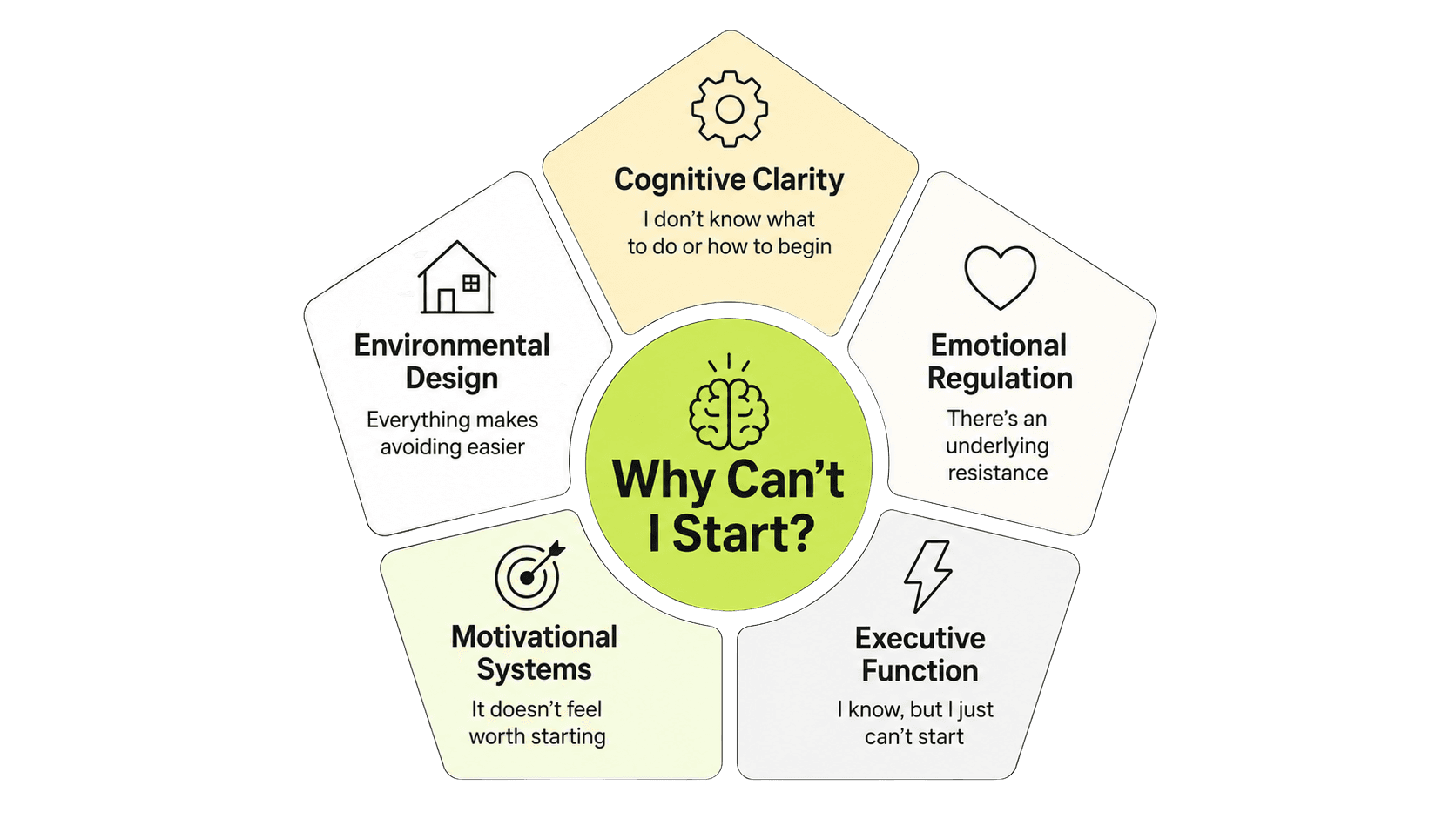
Cognitive clarity: when the task is too big, too unclear, and alien, your brain cannot initiate a first step because it simply doesn’t know where to begin.
Executive function: your brain knows what to do, but can't bridge an intention with action. It’s like having a car with a malfunctioning engine.
Emotional self-regulation: fear, perfectionism, shame, or anxiety about the task is adding extra layers of pressure that prevent you from getting started.
Motivational systems: when there is no reward in sight, there’s no point in starting the task.
Environmental design: your surroundings, habits, or routines are actively working against you
If you'd like to discover more about the specific ways these systems fail, I wrote an article, "Why you can't start - and what to do about it," that covers all 5 in depth. Or you can take our quiz to find out which systems are failing you, so you know exactly what fixes to try first.
8 task initiation strategies
Strategy 1: Break it down until it's very small
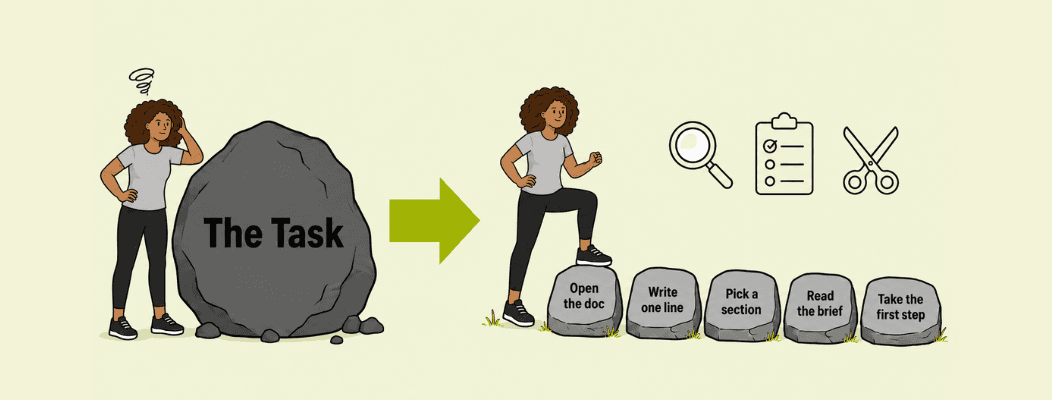
Core idea: When a task is too big or too vague, your brain can't find the door in. And when there's no entry point, there's no start.
By breaking the first step down into smaller steps until it’s small enough to start, you give yourself one definite action to take. That’s all you need to get moving.
Why it works:
Creates cognitive clarity: Breaking a task down creates mental clarity. It turns something unclear into steps your brain can understand and act on. The task might still feel big, but now you have a way in, and that’s what matters.
Zeigarnik effect: a task that's been started stays mentally "open." Your brain naturally returns to it. I often call it "a mental itch." Until I finish something I've started, it won't go away.
How to apply:
Identify the single physical action that begins the task (not "write the report," but "open a blank doc").
If that still feels hard, shrink it further ("move the laptop to the desk").
Commit only to that. Nothing else. Don't overwhelm yourself with a whole to-do list for the week. Just the small first task to get your foot through the door.
🚀 Best when Cognitive Clarity & Executive Function are failing
Strategy 2: Use the 5-minute rule (or 2-minute)
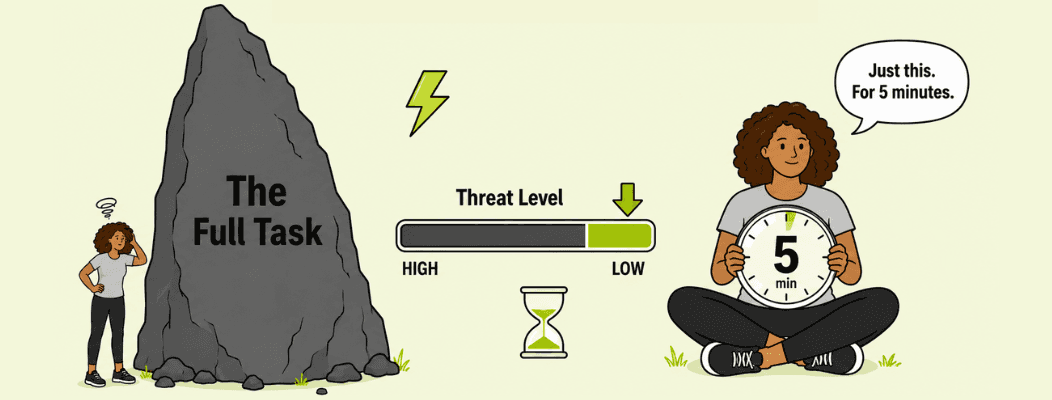
Core idea: Big goals and tough tasks can feel overwhelming. Your brain sees all that potential effort as a threat to its already busy and stressed life. By committing to work for only 5 minutes, you're lowering the perceived risk and telling your brain, "This is not dangerous."
Why it works:
Humans respond well to deadlines. When you know when the task will end, it straight away looks more manageable than an endless string of to-do lists.
Low activation energy. The activation energy required to complete a 5-minute task is much lower than that required to start a 5-hour session. Most brains that cannot manage 5 hours can easily manage 5 minutes.
How to apply:
Use a physical timer, not a mental one. Externalizing the commitment matters.
2-minute rule (from GTD/Atomic Habits) for very small tasks; 5-minute rule for bigger ones.
You can also combine this with Strategy 1. Taking a tiny first step and adding a time limit makes it even easier to begin.
Note: most people find that once they start, they often keep going. But remember, you don’t have to. There's no shame or guilt if you stop after five minutes. In fact, that’s the goal.
🚀 Best when Executive Function and Motivational Systems are failing
Strategy 3: Condition yourself to work in your workspace
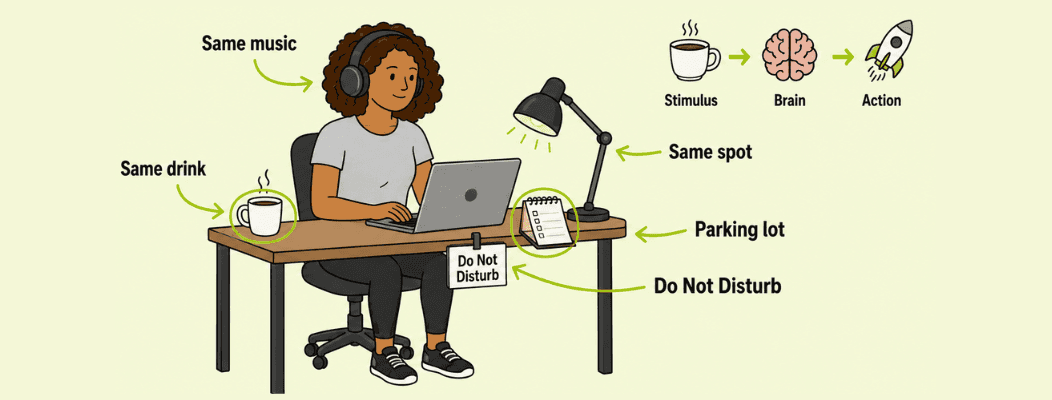
Core idea: Train yourself so that a certain time, place, or routine signals your brain to start working. This way, you don’t have to make decisions or set things up each time. All that is left to do is just begin.
Why it works:
Classical conditioning: repeat the same stimulus-action pair enough times, and the stimulus triggers the action automatically.
Start autopilot. The goal is to make starting a task as automatic as making your morning coffee.
How to apply:
Designate a specific space for deep work. Even a single chair or corner counts.
Create a consistent start ritual: the same drink or snack, the same place, the same music, the same smell, the same warm-up, or the same clothes. The goal is to condition your brain so that once all these conditions are met, it knows what comes next: work.
Pair conditioning with distraction removal. Leave your phone in another room if you can handle the separation anxiety. Or just switch off noisy notifications but keep the most important ones on, so you don’t keep worrying about your loved ones while you work. Tell everyone in your home that you are focusing on work and that they need to make their own food and find their own things by themselves during this time. Getting a “Do not disturb” sign might not be overdoing it, either.
Try the "Parking lot" technique: keep a notepad nearby for stray thoughts. When a distracting thought appears, write it down, so you can look it up later. This way, you don’t get carried away in the moment, and your brain has “released” the thought and put it on paper, so you can go back to working.
🚀 Best when Environmental Design & Executive Function are failing
Strategy 4: Reward the start
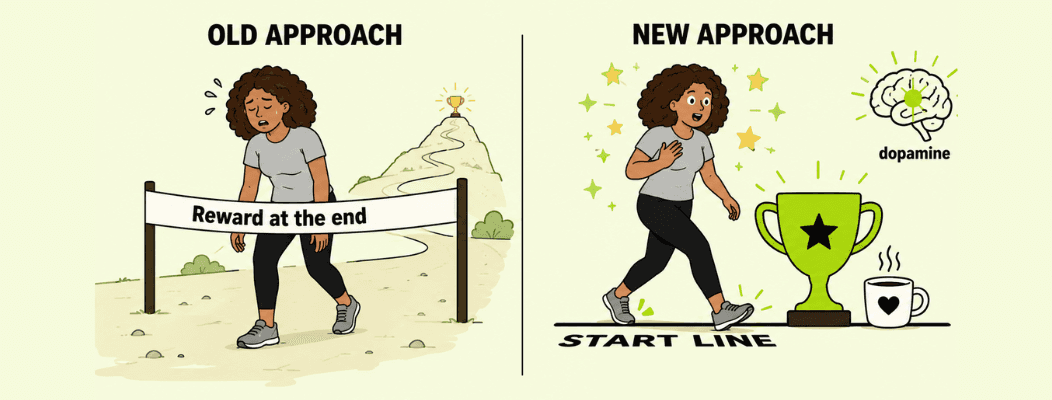
Core idea: It is common to reward yourself after finishing a task. But if you struggle with task initiation, it makes more sense to reward yourself for just beginning. Work for five minutes, then enjoy your reward. Your brain will release some dopamine that will motivate you to keep going.
Why it works:
Cornell research: immediate rewards (vs delayed) significantly increase intrinsic interest and persistence.
Dopamine hit. If you train your brain, its reward system can activate as soon as you start a task. You’ll get a boost of feel-good hormones right at the beginning.
How to apply:
Give yourself something enjoyable as soon as you start: a coffee, your preferred playlist, or anything else you love enough to motivate you to start.
Gamify: assign points to the act of starting (not finishing); let points accumulate toward a larger reward.
🚀 Best when Motivational Systems and Emotional Self-Regulation are failing.
Strategy 5: Don't work alone; body double
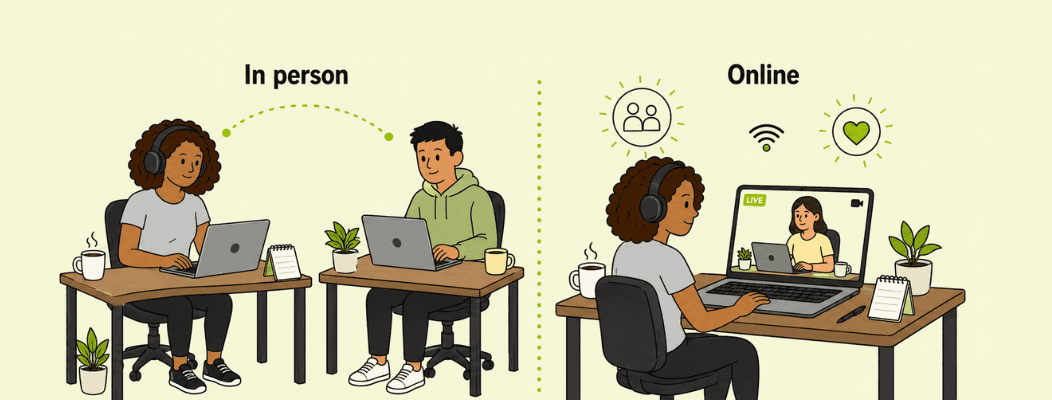
Core idea: Social accountability is what kept humans going for thousands of years, and it still works. In fact, for many people, it's the only thing that works.
Having someone else present while you work, in person or online, changes how your brain computes a task. Being observed when you work triggers a social accountability circuit response in your brain. This gives your brain a push that internal motivation alone simply can't replicate.
You’re not alone with the task anymore. For many people, that’s enough to help them begin.
Why it works:
Brain circuits. Knowing someone is nearby activates social accountability circuits that bypass the avoidance response.
Reduced avoidance. Social accountability reduces avoidance through gentle external pressure. Nobody's judging you; they're just there.
Compensatory mechanism. For many people with executive function challenges, external regulation compensates for what internal regulation fails to do.
How to apply:
In-person: work alongside a friend, family member, or at a café. You can tell them what you're working on, or not. The mere presence of another person changes how your brain perceives the task.
Online: Apps like Focusmate and Flow Club pair you with a stranger for a timed accountability work session. The setup is usually fairly simple: you declare your goal at the start, work, and check in at the end.
Asynchronous version: study streams or co-working livestreams on YouTube. If you can trick your brain into believing that people in the video are real and observing you, the bonus is that you don’t have to go on a call with a stranger who might have a questionable character and nefarious intentions.
Catch-ups with the accountability partner: ask a friend, family member, or coworker to become your accountability partner. Send them a brief daily message, e.g., "starting X now." This also activates social accountability circuits in your brain.
🚀 Best when Motivational Systems and Emotional Self-Regulation are failing.
Strategy 6: Be radically kind to yourself
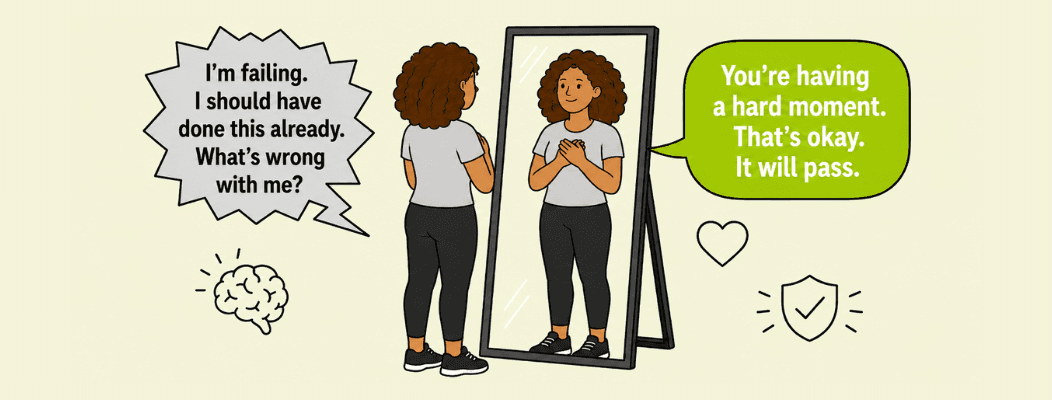
Core idea: Shame and self-criticism don’t actually motivate you. They just add more pressure, and that extra pressure can make you freeze. Self-compassion takes away some of that pressure, making it easier to get started.
Shame spirals and emotional blocks are different in nature from the other challenges listed here. Until you address those feelings, other strategies won’t work. You need to ease the emotional strain before any productivity tips can help.
Why it works:
Research: procrastinators consistently show lower self-compassion and higher stress levels. Emotional reasons for struggling to get started, such as shame, fear of failure, or guilt, add to the task load, making it even harder to start than before.
Lowers the threat. Being kind to yourself takes some of that pressure off, which, in turn, lowers the perceived threat of the task for your brain.
How to apply:
Self-compassion break: when stuck, pause and speak to yourself the way you'd speak to a friend in the same situation. Would you beat them up for freezing in the face of a threat? Didn’t think so.
Reframe internal language: Instead of saying or thinking "I'm failing at this," say "I'm having a hard moment, and that's okay. It will pass. "
Walk down memory lane: take a moment to remember times when you started, finished, and succeeded. You’ve probably faced real challenges and gotten through them thanks to strength, adaptability, and resourcefulness. Give yourself credit for those moments.
🚀 Best when Emotional Self-Regulation is failing.
Strategy 7: Warm up with a small win
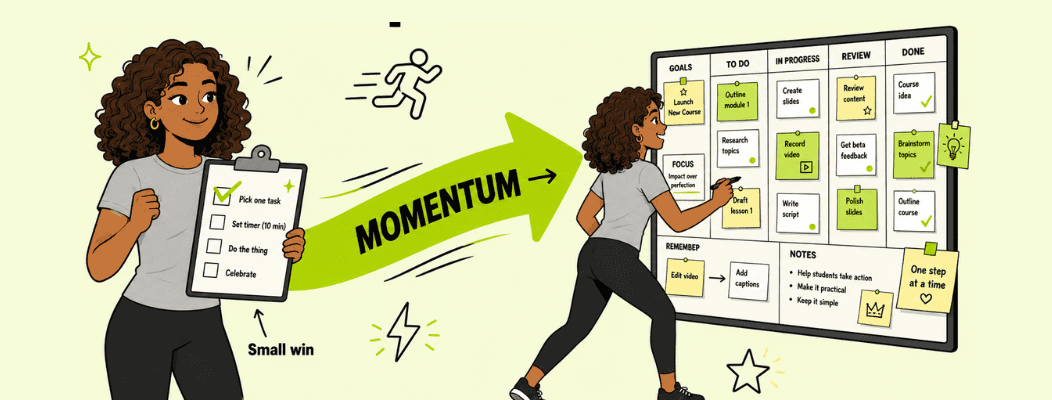
Core idea: If something seems impossible (and sometimes rightfully so, since some projects take months to complete fully), don’t force yourself. Try starting with an unrelated or remotely related task to build momentum, and let that small win help you get going.
Note: be sure to limit your warm-up time so it doesn’t become a way to avoid the main task. Too much research or preparation can feel productive but it’s really just a sophisticated avoidance.
Why it works:
Momentum is transferable: completing any task, even a slightly adjacent or unrelated one, generates a low-level sense of agency.
System warmup. This strategy helps mitigate the “cold start” problem. Your brain just needs to get moving, and even a small win, checking something off a list, can give you the boost you need.
How to apply:
Task-adjacent warm-up: gather materials, open relevant tabs, re-read your last note on the project, do some light research, or even just prep your workspace. Do things that will help you get the task done, even farther down the road.
Brain dump: for 3-5 minutes, write down all of your thoughts about the task, how you feel, and what things you are uncertain about. Don’t edit it. The goal here is to clear out the brain fog.
Unrelated easy win: wash 2 dishes, respond to a quick message, and afterward transition to the main task.
🚀 Best when Executive Function & Emotional Self-Regulation are failing
Strategy 8: Apps that help you start
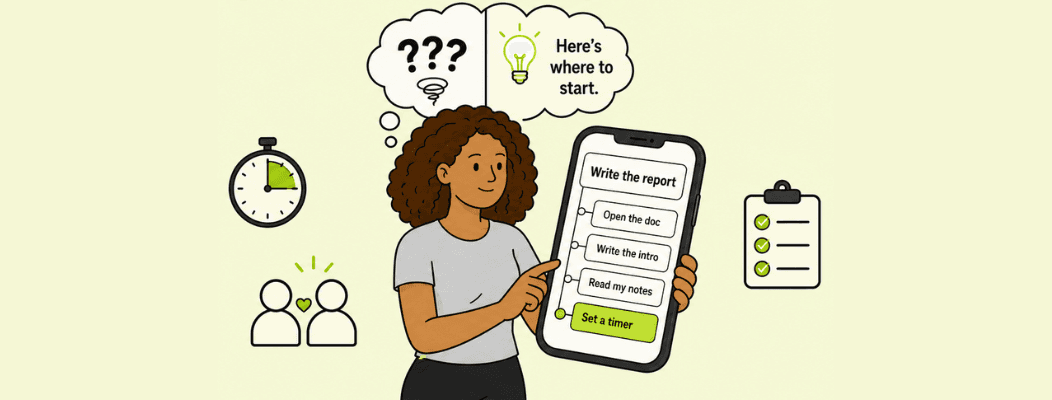
If some of these strategies sound good in theory but overwhelm you in practice (e.g., breaking a big goal into small tasks), technology can help make things easier.
Each app below works best for a specific failing system. And since they were built for people with ADHD, task initiation paralysis, and executive dysfunction, they all focus on task initiation.
Full transparency: I built Luumer because I kept freezing in front of self-started projects. I had big, overwhelming goals and no idea how to achieve them or where to begin. I needed something that didn't just break goals down, but adapted to my life and my pace. And wasn't "noisy" about it. So yes, I'm biased. But I also know exactly what people with initiation issues need.
What it does: AI-powered planner that breaks big goals into small, manageable tasks that are based on your specific context, preferred task size, schedule, and time availability.
What makes it different from a regular to-do list:
Asks you questions to understand your situation before generating tasks
Adapts over time as you make progress (or don't)
Helps you stay focused with timers and smart notifications
Best for: anyone who gets paralyzed at "where do I actually start?" Luumer answers that question, every day.
🚀 Best when Cognitive Clarity & Executive Function are failing.
What it does: pairs you with a stranger for a timed video co-working session (25, 50, or 75 min).
The social contract: declare your goal at the start, work silently, report back at the end.
Why it works for initiation: the external commitment at session start is the trigger. You've told someone what you're doing, and that activates accountability.
No accountability partner needed. A new match is available whenever you need one.
🚀 Best when Motivational Systems & Emotional Self-Regulation are failing.
What it does: Tiimo is a visual planner with AI assistance. It was designed with neurodivergent users in mind, with community support. The app includes streaks, rewards, a focus timer, and customizable start cues.
The initiation angle helps build and reinforce environmental and routine triggers.
🚀 Best when Environmental Design & Executive Function are failing.
What it does: free, browser-based AI toolkit; one of its tools takes any task and breaks it into steps on demand. No account needed.
Best for: the lowest-friction entry point. Useful if you want to test whether task-breaking helps you before committing to a complete app like Luumer.
🚀 Best when Cognitive Clarity is failing.
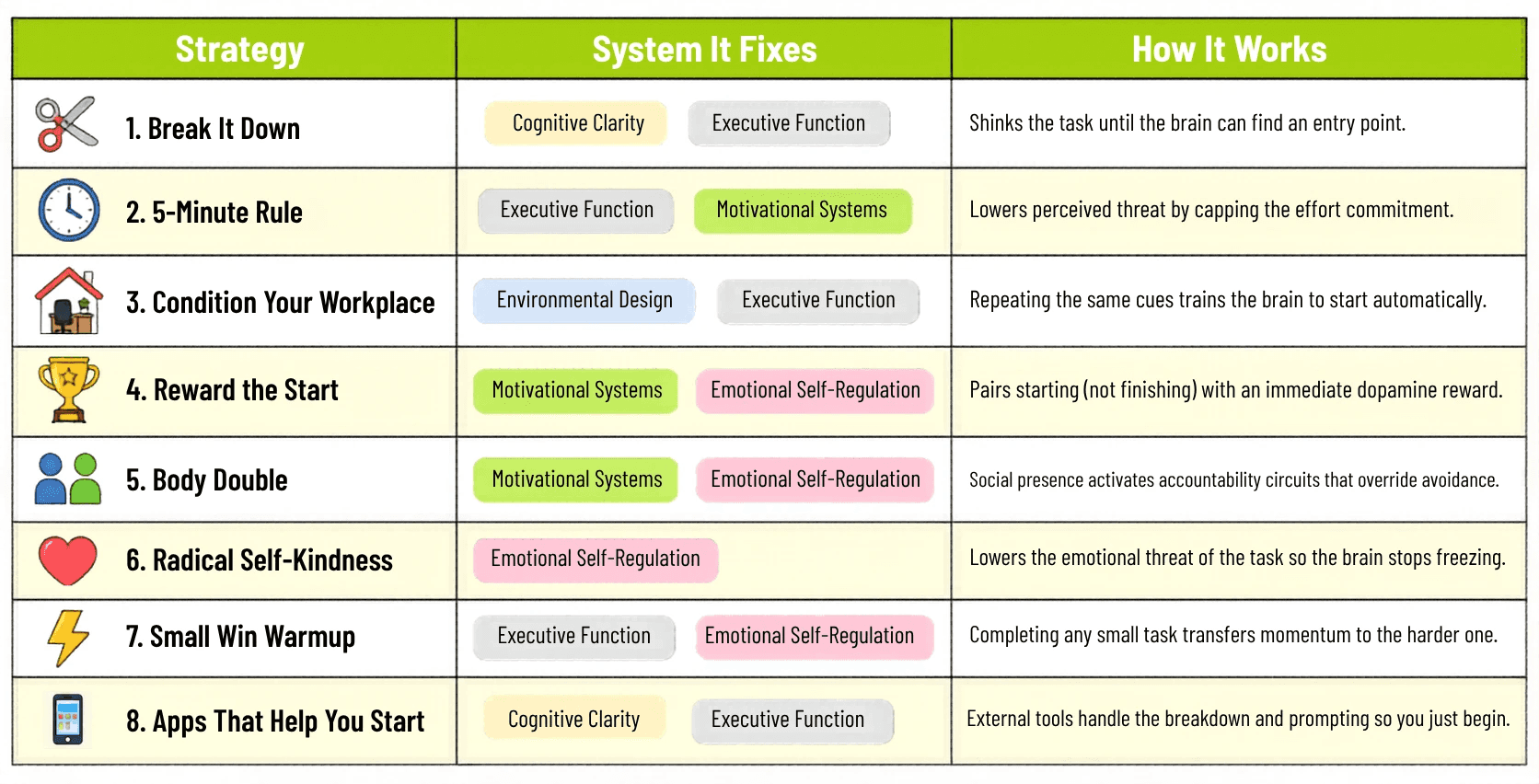
8 strategies at a glance
When strategies alone aren't enough
If you’ve tried a few strategies and nothing is working, it doesn’t mean you can’t be helped. It might just mean the root cause is deeper than these strategies alone can address.
Task paralysis caused by complex trauma, undiagnosed ADHD, or depression often needs more than just tips and tools.
Talking to a professional, like a therapist or an ADHD coach, can really help. Some problems are bigger than what a five-minute timer can solve, and recognizing that is important.
Final thoughts
Once you know which system is holding you back, start with one strategy or two if they work well together. Give it a real chance before switching. Think of it like building a muscle: start slow and increase gradually.
Not every strategy will work for you, and that’s normal. You may need to try a few before you find what fits. Over time, it gets easier. At least, that’s been true for me once I found what strategy worked for my brain.